Mind it

Mohammed Bouazizi, 26, sold fruit and vegetables illegally in Sidi Bouzid, Tunisia because he could not find a job.

Every day, he would get harassed by the corrupt policemen who would take away his day’s earnings.

December 17, 2010 as once again the police harassed him taking his wares away, he decided to self-immolate himself triggering a multi-year arab spring revolution across the middle-east leading to unseating of such powerful dictators as Col Gaddaffi in Libya to Hosni Mubarak in Egypt.

A self-immolation in one small town of a little country igniting a revolution in a large part of the world is unimaginable.

However, triggers work that way.

Triggered

A large number of decisions on day-to-day basis get triggered sometimes by months and at times by years of bubbles that are building in and around people.

The global equity market-cap as on Dec-19 was 93Tn USD.

As we progressed to March-20, this declined by over 30%.

However, at the end of Dec-20, the market cap was up 17% over Dec-2019 reaching 109 Tn USD and stands at 120 Tn USD as at end of July-21.

A lot of investors not only imagined a global catastrophe and hence a large and enduring decline in the stock markets, but they pulled out actively and went into cash.

The interesting part is that in 2019 global equities had done very well with market cap going up by almost 20%

Which means share prices were already higher by every kind of valuation metrics.

The fact that investor decided to pull out in March 20 and came back subsequently when the markets recovered taking the markets to even bigger highs constitute the “behaviour gap” that impacts investor returns.

Risk Perception

It is well known that it’s not the actual risk but its perception that defines investor behaviour.

Which in turn determines cash flows in the markets.

Cash flow-both in/out will in turn determine volatility in performance.

Volatility in turn will determine “The Gap” between fund returns and the investor returns.

Investor Mindset

“Risk” has to be seen as permanent loss of capital and not just mark to market losses.

What seems like sunk cost in the short-run is actually the investment that can pay-off provided as an investor you have a process and philosophy around what you are trying to achieve.

Often heard complaint from investors is that the markets are expensive.

However when the markets fall, they start worrying about getting into a “value trap”.

This takes a very linear view of how the larges universe is operating.

While it is OK at times to look at “0”/”1” scenarios, it is also worthwhile to consider the merits of businesses/investments that you own and how they shall get impacted and take a slightly longer-term view of your investments.

Here are some suggestions to think about:

  1. How much loss can I take on my portfolio and on individual components?
  2. What would the world need during a particular crisis? Which businesses can benefit from that need, and do I own such businesses?
  3. Instead of pulling out of the markets, should I re-orient my portfolio?
  4. Are there businesses in my portfolio that see their businesses continue despite the crisis/recession and other negative factors; how’s is their balance sheet, can they raise money, can they survive the crisis?
  5. Take help from experts

End of the day, “fear” is necessary and it prompts you to take actions.

However what is even more important is “calm” so that you take the right action and not just take “A action”

Happy investing-follow my twitter handle @manver1974 for more such shares
The “Actual Correction”

Here is an interesting discussion I witnessed recently:

SGX now 16705,  ++ 85; After correction of 20-40% , many midcaps looks attractive..

Start accumulating.. Only for Investor

Absolutely, but when d actual correction sets in d markets, most of these mid-caps will correct far more 🙃Absolutely Devang, but when d actual correction sets in d markets, most of these mid-caps will correct far more 🙃

It got me thinking what’s an actual correction and when would it set up and is it worth waiting for it.

Almost every year there is a correction.

In the past 20 years there have been 8 over 25% corrections and 4 over 10% corrections apart from some 8-9% corrections.

However still the markets delivered a 12.7% CAGR making INR 1L-INR 10,86,000.

Now maybe some people were lucky and timed the markets well and made more than the markets.

However, for majority it would have worked just fine being in the markets and getting the 12.6% CAGR.

While lot of us track the index levels, individual scrips go through price/time corrections from time-to-time:

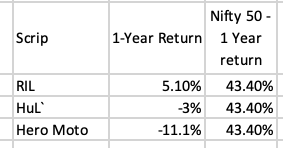
Here are some of the prominent stocks that have under-performed the markets over last 1 year:

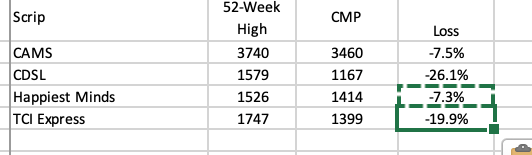
Some of the high flying stocks of last few months

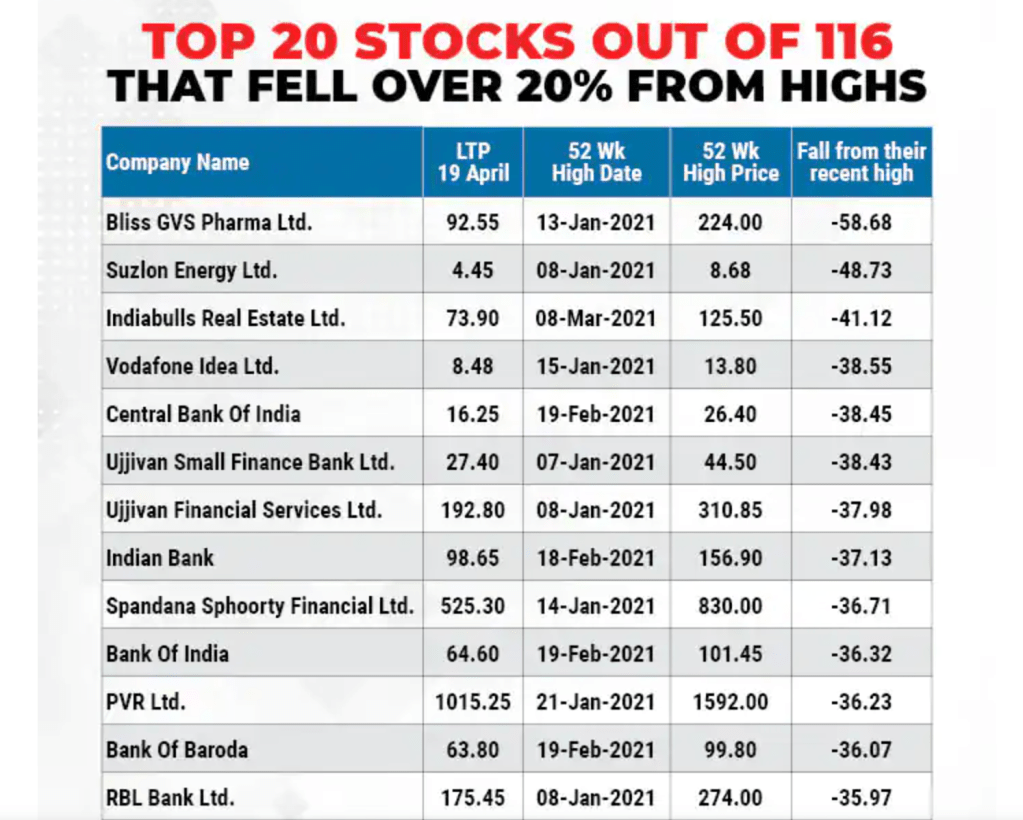
Here is another list from Moneycontrol.

As I often say there is no right or wrong in investing.

It only depends upon how you look at things and your relationship with money.

An investor should do what they feel works best for them so by all means wait for a correction, if that’s what works for you mentally.

All I suggest is “stay the course” irrespective of where the market goes so at-least your disciplines pays off.

Follow my twitter handle @manver1974 for more such shares.

Model Gone Mental

https://www.bloomberg.com/news/articles/2021-08-21/wall-street-just-as-baffled-about-markets-as-it-was-last-year?srnd=premium-asia

This article on Bloomberg just sums up accurately the confusion that is persisting among those who are investors and the ones who manage their investments

Who by the way are just as human as the investors whose money they manage.

Over time people develop short-cuts to make sense out of what’s happening around them.

Behavioural analyst while recognising these short-cuts suggest creating “mental models’ that can help you quickly analyse a situation and respond.

Mental models help you make sense of the world.

In a famous speech in the 1990s, Charlie Munger summed up the approach to practical wisdom through understanding mental models by saying: “Well, the first rule is that you can’t really know anything if you just remember isolated facts and try and bang ’em back. If the facts don’t hang together on a latticework of theory, you don’t have them in a usable form. You’ve got to have models in your head.

However as usual you can’t become a servant of your mental model.

The idea is to demystify the complex equation which shouldn’t make you assign arbitrary premium or discount to it.

The article above says-Twelve out of the 21 forecasters tracked by Bloomberg expect the S&P 500 Index to fall into the holidays. The spread between the highest and lowest target is 24%, the third-widest in nearly a decade.

The uncertainty is just as acute among some Treasury analysts, with those at Bank of America assigning a 100-point range to their 10-year yield forecast for the end of 2021.

If the professionals with all their tool kits and data can’t make sense of things than can you expect retail investors to do so.

The conflicting issues at hand are:

  • Are Markets overheated?
  • Is inflation here to stay?
  • Why are bond yields still so low?

The baggage of linear thinking models makes people ignore the underlying.

Let’s look at some simple data.

Nifty on March 20, 2020-8745

Nifty EPS on March 20, 2020-INR 443

Nifty P/E on March 20, 2020-19.72

Nifty on March 19, 2021-14744

Nifty 1-Year Forward projected EPS- INR 735

Nifty 1-year Forward projected P/E-20

So from the bottom till now, do you see a big difference between valuation.

The speed of the rally was met forcefully by the speed of earnings growth.

And as it often happens when something unexpected like this happens-“mental models” crack.

You can use the above to solve for the other 2 problems above.

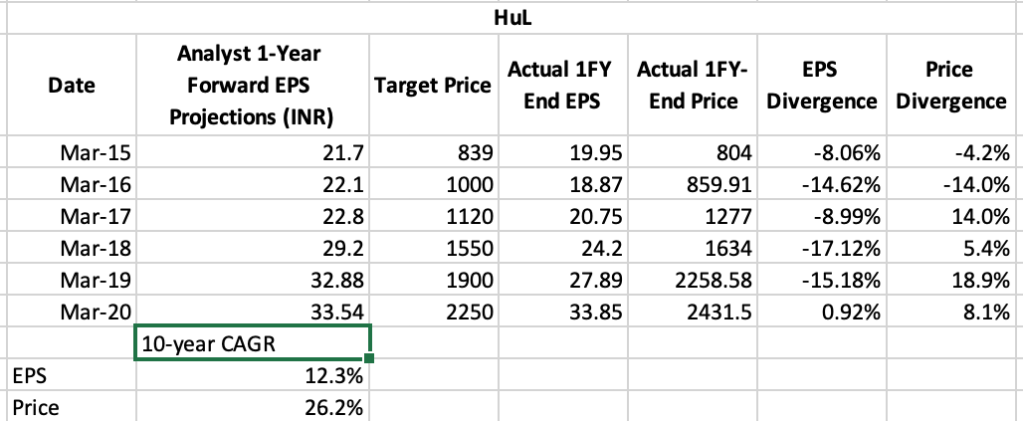
Here is another example that will sum-up the argument for you.

If you notice there is not even 1 year in 6 that any expert came close to projecting the accurate EPS and price target for the company.

These are data points and often the outlook is short-term that can often ignore the drivers other than last quarter earnings which get projected into future.

n companies that have a track record of thriving in times of trouble. 

The bottom-line is “It’s really hard to know, it’s just so hard to predict so let’s prepare,”

The key is to focus on quality of what you are holding and let time do its magic.

Follow my twitter handle @manver1974 for more such shares.

Everyone is an Expert

“An expert is an ordinary man away from home giving advice.”

— Oscar Wilde

There are questions and confusions.

These create space for “Experts”.

In an experiment done in the US-50% of the recipients were advised a “Buy” while the other 50% were advised a “sell” on a stock.

Obviously 1 group got the right advice.

50% of those who got the right advise were again sent a “buy” and the other “50%” were sent a sell.

So on and so forth till some people who kept on getting the right advice became converts and believed in the expertise of the sender.

Often enough this is how expertise really gets established.

Keeping saying disaster will strike or “this will end badly”, “stock markets will crash”.

And as we know even a broken clock shows the correct time twice in a day, at some point the forecaster will be proven right establishing expertise.

Experts Galore

Today we have experts on everything-covid, health, weather, terrorism, economics, stock-markets.

Some people are on TV every-day as experts on almost every subject under the sky because they have a view which is made to sound like expertise.

And now these TV experts have been joined by the online experts whose job is to provide expertise.

Don’t believe me-check out-expertcentral.com; Xpertsite.com; Knowpost.com and several other such online portal where you can ask a question and an expert will respond.

What are the credentials of these experts-your guess is as good as mine?

Search for the “Right Answers”

End of the day-human beings have been looking for answers forever.

Some make an attempt to find the answers through their efforts while other rely on the “EXPERT” who has made the effort.

Earlier they used to seek divine intervention (guess its relevant even know) and now they have got human intervention.

Here is an exchange I witnessed today on one of my groups-

1 person asks-what’s the views on a particular stock.

Another person confused that company with a brand of hotels operated by another listed company gives expert advice on hotel brands, also recommending another stock to look at.

Best part, the company originally targeted has nothing to do with “hotels” but runs a textile company.

Reminds me of how stock ticker of online meeting interface company Zoom (ticker-ZM) was confused with Zoom technologies (ticker-Zoom) sending shares of Zoom Tech up by 1800%.

There is no “Shortcut”

When time is of essence and one might not have the competence to do the relevant research, it is easier to take the word of the expert rather than do laborious research.

Fraudsters know what people are looking for and they are ready to deliver.

Old school processes work and for good reason.

If you are looking for an answer, you got to do your research.

However, before you do that, you got to know what you are looking for?

It’s not easy however and that’s why you have genuine experts.

Now again genuine experts might be expensive but will save you a lot of heartburn and losses.

Who is an EXPERT?

Even if you are looking for an expert, you got to know who an actual expert is.

Just because someone is visible in media, doesn’t necessarily mean one is an expert.

I am sure you are aware that media wants to sensationalize you and has limited patience for genuine expertise.

They just want to push a quick point that is easily understood and digested by the audience.

Some benchmarks that can be used are:

  • Regulatory License and qualification
  • Association with an institution
  • Relevant Experience
  • Track-record and its consistency

Of-course even with all the above, those who are looking to take you for a ride will do so and in-fact some of the above makes it easier for people to cheat you and hence while it might take time, it is better to take that time to test the expert and their expertise.

Overtime, develop the ability to ask the right questions which is crucial to put the expert under pressure and test how good they are.

Nothing is finally 100% fireproof, however developing a process can certainly help.

For guidance write on manish.verma@manishverma.co.in or call on +919920741569

Follow my twitter handle @manver1974 for more such shares
One Size Fits……………

In his new book “Noise”, Daniel Kahneman gives example of his hypothetical friend Paul who was diagnosed with high blood pressure by his Doctor.

3 Months of different medicine tracks were still not able to bring down the blood pressure of Paul.

Meanwhile Paul had to move to a new city where a different Doctor told him to buy a home blood pressure kit to measure his blood pressure  and note down the readings.

According to the new Doctor, Paul didn’t have any blood pressure, he was suffering from “White Coat Syndrome” that raises blood pressure of an individual when they are in a doctor’s office.

One key task of a doctor is to make a diagnosis and sometimes it involves making a judgement and judgement can go wrong for a variety of reasons.

A thumb rule is often applied to make things simple.

However, the challenge with a thumb rule is that its simplicity itself makes it invalid in many if not all situations.

One Size fits All.

One-size-fits-all describes an item, situation, or policy designed to accommodate a large amount of people.

Something that is one-size-fits-all will not be an exact fit and is not tailored for every circumstance, but it will suffice.

One-size-fits-all came from the garment industry.

In the 1970s, many retailers carried items that were oversized;

They were designed to fit a range of sizes.

However by the 1990s, companies experienced a backlash from people who did not fall within the range of sizes for a one-size-fits-all item.

Most ready-to-wear designers began using the designation: one-size-fits-most.

It was just about this time when the popularity of the expression one-size-fits-all really took off. Note that one-size-fits-all is hyphenated.

One-size-fits in Investing

Recently the conversation on a business channels program on mutual funds made the following suggestion:

Investor should not have more than 8 schemes

2 debt schemes-ultra-short term; corporate bond fund; short-term; banking & PSU

6 equity schemes

– 2 large cap-One index & 1 active

– 2 flexicap-One concentrated on domestic stocks and another one with international exposure

– 1 small or midcap fund, however exposure should not be more than-25% of total exposure; and last but not the least

– 1 tax savings

How about considering the following:

  • What is the risk profile of the investor?
  • What is the investor saving for?
  • What is the time horizon for these goals?
  • Can the customer take the risk of mid/small cap?
  • Should it be mid cap or small cap?
  • Why only 6 equity scheme?
  • Why 2 for large, 2 for flexi but only 1 for mid/small?
  • Is this kind of concentration good for the client’s risk-profile?
  • If you are choosing only 1 scheme what should be the criteria?
  • Why international exposure and why not provide it directly rather than through flexicap scheme?
  • How much international exposure fits into client profile?

I am sure you can think of several other questions in this context.

The challenge of advice on a TV channel is that the advice can only be “one-size-fits-all” because of the very nature of the medium.

It’s just “Noise”.

Just like a garment of a particular size will not fit all, similarly an advice of a certain kind will not fit all.

I believe that time is not far when every portfolio will probably be investor as investor evolution will make them more aware of their specific need.

The key for the investor is to think about their specific situation rather that “follow the herd”.

Remember if you buy a shoe that’s not your size, it will either itch or keeping falling off your foot.

Decision is yours.

For guidance call +919920741569 or contact on manish.verma@manishverma.co.in

Follow my twitter handle @manver1974 for more such shares
Collecting the Dots

Moneyball (a popular book and movie) describes the successful strategy of Oakland A’s (baseball team).
The thesis is simple-Using statistical analysis, small market team can compete by buying assets that are undervalued by other teams and selling ones that are overvalued.

The best-known Moneyball theory was that on-base percentage was an undervalued asset and sluggers were overvalued.

At the time, protagonist Billy Beane was correct. Jahn Hakes and Skip Sauer showed this in a very good economics paper.

From 1999 to 2003, on-base percentage was a significant predictor of wins, but not a very significant predictor of individual player salaries. That means players who draw a lot of walks were really cheap on the market, just as the movie narrates

The DOTS Ignored

The dots were available in open, however were ignored by the bigger teams as they had the funds to buy what they thought were the best players.

The smaller teams were following the strategy of the bigger teams and failing.

There is always a lot of talk about “connecting the dots”, however very limited focus on “collecting the dots”.

When you don’t collect the dots, how would you connect them.

The journey has to start with collecting and not connecting.

If you leave it to luck, you will connect dots by accident.

However, if you start “collecting the dots”, it will become part of the process.

Barriers

Realization can come only when information is available.

However often there can be 4 barriers to information:

  • Awareness of the importance of the information
  • Attention-What is attention being paid and how important is it?
  • Past Experience-Baggage that prevents people from collecting the relevant information
  • Bureaucracy-Information not being shared due to bureaucratic reasons

Solutions

  • Consciousness-being aware of the need to collect the dots
  • Networking- Create a relevant network to keep collecting the dots
  • Collaboration-create community to reinforce collection
  • Categorization – Putting relevant information where it belongs

What it means is that a high level of consciousness and understanding of what information is relevant, collecting that information and processing that information is needed to collect and connect the dots.

While this is all process, what it starts with is knowing that there are dots, that you need these dots to complete the picture and then having the ability to go after this objective as a mission.

Collecting the DOTS-Investing

Investing has been a big pre-occupation for investors at large since the beginning of the pandemic.

Those who came after the fall got fantastic returns and created a template for those who missed to be part of the “Great Investing Game”.

Everyone became an investor and those who were not buying equities directly got “FOMO”.

India has been opening 1.8Mn broking accounts every month since the beginning of 2021.

The great rush to own equities and emulate the success of others is a big motivation.

Just reading this makes you understand the flaw in the thinking.

It’s not about investing but about participating in the “Gold rush”.

And we know how that ends.

Step Back-Look at the DOTS

Investing and success in doing investing is about taking a step back.

Understanding your objectives-and no it can’t be “make the same returns as your neighbor”.

You are not getting into gambling.

Your first objectives have to be to understand what you are getting into, why and what is your risk-reward.

This requires serious advisory and not “following the herd”.

It’s about “collecting the dots” and “connecting them”.

Advisor/Coach

Having a good advisor who can help you manage your instincts while getting you exposed to what you intend to do is important.

However even more importantly if you are looking to be a serious investor, understanding the process and you is very important.

This requires “deep thinking” and investment of time.

If you don’t/can’t invest this time, think about doing something else.

This is a dangerous place to discover yourself if you don’t know who you are.

“Collect the Dots” before you “Connect them”

Crypto 101-Part VI-Regulations Around the World

Crypto was envisaged as democratic, decentralized concept beyond the outreach of governments and central banks.

However, adaption on a widespread has multiple triggers:

  • Utility
  • Trust
  • Framework that’s understood easily

There is a legal framework that goes beyond the concept that requires recognition of any activity as either a business, investment, speculation and basis that categorizing any income accruing from these activities so that they can be taxed.

While the crypto believers wanted to avoid this very system, any wide-spread adaption will require enough number of people to have clarity on such matters to ensure there are no legal challenges as well as safety of their investments/activities against being declared illegal.

What Can the Govt. Do?

There are 3 different kind of reactions that can come:

  1. Adapt- Countries like Switzerland, El Salvador are good examples of adapters
  2. Regulate-Australia, Canada, Singapore, Thailand, South Africa, Indonesia, Germany, EU, Japan are countries that have taken early steps to regulate the crypto
  3. Ban-China, Vietnam, Ecuador, Macedonia, Qatar, Morocco, Bolivia are some of the countries that have banned crypto

There are still several countries obviously which are making up their mind with respect to crypto like India USA to count a few prominent ones.

The tables below provide a good summary of what’s happening in countries that have adapted/regulated crypto Vs. the others.

Adapters/Regulators

S. No.CountryCrypto-friendly normsRegulations addressing concerns of illicit use of cryptocurrencies 
1FranceFrance currently does not regulate cryptocurrency trading. However, it is slowly moving towards regulation.To combat anonymity of cryptocurrency transactions, it has proposed a new Ordinance is proposed with stricter AML and CFT norms, ensuring mandatory compliance with standards of the Financial Action Task Force (FATF).
2Switzerland1) Classifies cryptocurrencies as assets
2) Accepts Bitcoins as legal tender in some regions.
3) requires a license for DLT trading facilities.
4) It is home to the ‘Crypto Valley’, which is a fintech hub catering to cryptocurrency businesses in Switzerland and Liechtenstein.
5) It houses more than 900 companies, and the combined valuation of the top 50 companies is around USD 37.5 billion.
6) Switzerland’s principal stock exchange, SIX Swiss Exchange, announced in January that its trading turnover for crypto products crossed USD 1 billion in 2020.
Cryptocurrencies and operation of trading platforms come under the scope of Switzerland’s AML law. Persons who exchange cryptocurrencies for fiat money and vice versa are also regulated under this law.
3GermanyCryptocurrencies are treated as financial instruments under a recently enacted German law. It introduces new licensing requirements for cryptocurrency businesses.Pursuant to the new law, cryptocurrency businesses are subject to Germany’s AML law.
4NetherlandsTrading in crypto-currency is regulated in the Netherlands. In May 2020, the Dutch AMLD5 Implementation Act was passed. The Act requires crypto-exchanges and crypto custodian wallet providers to register with the Dutch central bank to offer services in the Netherlands.The Dutch Implementation Act also updated the existing anti-money laundering rules to implement EU’s AMLD5 directives in the Netherlands. TCrypto service providers in the Netherlands have to record and verify customers identity, monitor transactions and file Suspicious Activity Reports (SARs) with local law enforcement agencies.
5European Union (EU)The EU Commission has introduced a directive on ‘Markets in Crypto-assets’ to regulate trading in crypto-assets and support digital finance in all EU states.All EU states have to follow the AML Directive 5 which has strict rules to combat money laundering. Member states are required to include cryptocurrency businesses within the ambit of these AML obligations. EU has also introduced an Action Plan to prevent money laundering and terrorist financing, beyond the standards adopted by the FATF.
6USASome states in USA have regulated cryptocurrencies while others are considering laws to regulate. 
New York has proposed a conditional licensing framework to make it easier for start-ups dealing in virtual currencies to operate.
Wyoming has already passed a bill allowing the creation of a bank which is specially meant to allow business to hold digital assets safely and legally.
Oklahoma has introduced a bill authorizing the use, sale and exchange of cryptocurrencies within government agencies. 
The Financial Crimes Enforcement Network of the US Treasury Department has issued a draft law requiring virtual currency operators to maintain records, and verify the customer’s identity in transactions involving virtual currencies or digital assets. The US Department of Justice has also suggested future strategies to combat illicit uses of cryptocurrencies including promoting law enforcement awareness and expertise in cryptocurrency technology to efficiently conduct investigations.
7Australia[3]The Australian Taxation Office has a guidance document on tax treatment of virtual currencies.
The guidance states that the transactions related to crypto-currencies are “akin to a barter arrangement, with similar tax consequences”.
As per the guidance, the digital currencies are not money. The Australian Securities and Investment Commission has issued a guidance on regulation of certain crypto-currencies as ‘financial products’ under its securities law. The guidance indicates that entities carrying on a cryptocurrency business need to be licensed.
In 2017, the Australian government amended its AML/CFT law to require digital currency exchanges to register with the Australian Transaction Reports and Analysis Centre. They must also implement the necessary AML/CFT measures to mitigate the risks of money laundering, and to identify and verify their customers’ identity.
8CanadaIn 2018, the Canadian Securities Administrators (CSA) issued a notice clarifying that securities law requirements will apply to crypto-businesses offering coins or tokens.
In January 2020, another notice clarified the situations where securities law would apply to platforms facilitating trading of crypto-assets. 
From 01 June 2020, Canada’s money laundering law requires all entities dealing in virtual currency to registerwith the Financial Transactions and Reports Analysis Centre of Canada (‘FINTRAC’) and implement the applicable AML/CFT measures.
9SingaporeTrading in cryptocurrencies is legal and is regulated by the Monetary Authority of Singapore under Singapore’s Payment Services Act, 2020.
Cryptocurrency businesses have to obtain a license to operate a cryptocurrency exchange.
Public offerings or issues of digital coins are also regulated under Singapore’s Securities and Futures Act, 2001. 
10South KoreaIn March 2020, the South Korean Parliament amended its ‘Act on Reporting and Use of Specific Financial Transaction Information’ to extend the AML/CFT obligations to crypto asset service providers, including crypto-currencies and crypto-exchanges.
The amended law requires crypto asset service providers to register with the Financial Services Commission and partner with one regulated bank for handling deposits and withdrawals.
The law requires crypto asset service providers to comply with enhanced KYC and AML rules. Crypto asset service providers will have to file suspicious transaction and currency transaction reports with the Korean Financial Unit, and conduct customer due diligence.
11South AfricaIn April 2020, South Africa’s Intergovernmental Fintech Working Group (‘IFWG’) released a position paper on regulation of crypto-assets recommending South African government to employ clear “policy stances”, “enforce” strict oversight and codify AML measures for policing crypto-businesses.
In November 2020, South Africa’s Financial Services Conduct Authority released a draft declaration of crypto-assets as a financial product under South Africa’s financial services law.
If enforced, this law will require crypto asset service providers to apply for authorisation as a financial services provider.
There are no AML/CFT compliances specifically for crypto-currency currently in South Africa. South Africa’s AML law requires all businesses including crypto asset service providers to report suspicious and unusual transactions to its Financial Intelligence Centre.The IFWG’s position paper has recommended the government to introduce enhanced AML/CFT requirements for crypto asset service providers. This will include conducting customer identification and verification, customer due diligence, keeping records, monitoring for suspicious and unusual activity on an ongoing basis, and reporting of suspicious transactions to the Financial Intelligence Centre.
12ThailandThailand passed a law in May 2018 to regulate businesses relating to crypto-currencies and digital tokens under the supervision of the Office of the Securities and Exchange Commission (SEC).
Any entity interested in offering digital tokens has to obtain approval for offering from SEC.
On the other hand, all entities wanting to operate as digital asset business operators have to obtain a license from the finance minister on the recommendation of the SEC.
In November 2020, Thailand’s finance ministry notified the Digital Asset Business Notification to recognise new categories of digital asset businesses, and the Digital Asset Business Licensing Notification to introduce additional licensing requirements for such businesses.
Digital asset business operators and digital token portal service providers are regulated as financial institutions under the Anti-Money Laundering Act B.E. 2542 (1999) and are required to implement AML measures prescribed therein.
13IndonesiaThis is a unique example of a country which initially banned cryptocurrency, and then legalized it.
In January 2018, Indonesia banned all payment system and financial technology operators from processing virtual currency transactions.
However, in 2019, the Indonesian government published regulations to regulate trading of crypto assets as commodities under the supervision of its Commodity Futures Trading Regulatory Agency.
Any entity dealing in crypto assets as commodity futures must comply with AML/CFT norms.
The entities are also required to report to Indonesian Financial Transaction Reports and Analysis Center.
14Japan[5]Under Japanese law, crypto-assets are defined and regulated under the Payment Services Act, 2009 (PSA 2009). All business entities interested in operating crypto-asset exchange services are required to be registered with the Financial Services Agency of Japan. Security Token Offerings and Initial Coin Offerings are regulated under Japan’s Financial Instruments and Exchange Act (FIEA).Under the Act on Prevention of Transfer of Criminal Proceeds, crypto-asset exchange services have to comply with advanced KYC procedures. These businesses are required to verify identity of customers, record and verify transaction records and report suspicious transactions to the concerned authorities.

Countries that Have Banned

S. No.CountryStatus of ban
1ChinaAccording to a notice issued by various Chinese government agencies jointly, ‘fundraising and trading platforms’ such as crypto-exchanges are prohibited in China. All initial coin offerings in China are also illegal and prohibited. However, there is no law or regulation which prohibits Chinese people from holding or transacting in crypto-currencies.[2] Thus, the ban envisaged by the Indian government will likely be wider in scope than that imposed by China.
2EcuadorIt passed a law banning Bitcoin and decentralized digital currencies in 2014. The Central Bank of Ecuador clarified that Bitcoin and other decentralized digital currencies are effectively banned in Ecuador. It also clarified that the purchase and sale of crypto-currencies through the internet is not forbidden, but the same do not qualify as legal tender.
3MacedoniaIn 2016, the National Bank of Macedonia issued a statement prohibiting Macedonian residents to have investments in cryptocurrency.
4Saudi ArabiaThe Saudi Arabian Monetary Agency has issued statements warning against trading in virtual currencies as they are out of government supervision. It was further clarified that virtual currencies are not approved as official currencies. In 2019, the finance ministry reiterated its warning against dealing or investing in virtual currencies, including crypto-currencies.
5MoroccoThe Moroccan Exchange Office informed the public that transactions through virtual currencies constitute a violation of the exchange regulations and are subject to penalties and fines. However, the press release also stated that various financial institutions in Morocco are following the evolution of virtual currencies in Morocco with interest.
6QatarIn February 2018, Qatar’s Central Bank issued a circular to banks declaring Bitcoin as illegal, and prohibited all banks from dealing with crypto-currencies. In January 2020, the Qatar Financial Centre (QFC) also announced that it will ban activities related to cryptocurrency.
7VietnamIn October 2017, the State Bank of Vietnam issued a decree on cryptocurrency outlawing the issuance, supply and use of cryptocurrencies. It also imposed fines up to 200 million dongs. The directive became enforceable in 2018. In March 2020, the Vietnamese finance ministry reportedly established a Digital Asset Research Group to propose guidelines and regulations on crypto-related activities.
8BoliviaThe Central Bank of Bolivia effectively banned crypto-currency, stating that the use of coins not issued or regulated by countries or zones, as well as the processing of electronic payment orders in currencies and monetary denominations not authorised by it in the field of the national payment system, are illegal and prohibited.

Between the adapters, regulators and those who are banning the crypto, it is an evolving space.

However given the numbers of prominent countries that have chosen regulation, means that this asset-class is here to stay and will continue to retain its space.

For guidance contact on manish.verma@manishverma.co.in or +919920741569

Follow my twitter handle @manver1974 for more such shares
What the Books Don’t Teach You?

Post is inspired by a Twitter Thread by @sahilbloom regarding the book “Good to Great”. This is not a criticism.

It’s just a look at how you think about what can be applicable to you Vs. looking at things that sound good but might not be for you.

Jigsaw Puzzle

The beauty of a jigsaw puzzle is that it makes you think of possibilities and combinations that stir your imagination and the thrill of putting it all together even if you have solved the puzzle hundreds of times.

Every time it seems like there is a new dimension to the problem.

You randomly pick up pieces and try to put them together to see if they fit in.

Sometimes they do and at others they don’t.

Through this hit & trail method you arrive at the right combination.

There are similarities that our life and whatever else we do to a jigsaw puzzle.

However, the challenge in life is that the life-puzzle is infinite and hence pieces never seem to fit together.

The same thing happens with business, there are so many moving parts that to think that you can solve the jigsaw puzzle when life and business is changing by the moment around you is giving yourself too much power that you don’t actually possess.

What Characterizes a Business?

Products, brand, technology, intellectual property give competitive edge to the company to succeed in the marketplace.

However, the piece of the puzzle that makes and keeps a business a running ship is its culture and its biggest bane that ultimately can push it back.

When a company is successful, its culture is hailed and when it stops being a market leader or fails, the same culture is reviled.

Who is talking about GE today?

In Management meetings, often the CEO asks, how do I improve the efficiency, productivity, growth of the Company?

Focus groups are created, and initiatives are laid down, often times without realizing that the pieces being created do not fit the puzzle and maybe not even required.

Then there is lure of the “Latest Management FAD” that a consultant with a best-selling book behind brings to the table.

Good to Great

11 companies participated in “Good to Great” original list-

Wells Fargo, Nucor, Kroger, Abbott, Gillette, Circuit City Store, Fannie May, Kimbery Clarke, Philip Morris, Pitney Bowes & Walgreens.

This is apart from the 6 companies that the author says could not sustain “Greatness”.

These are- Burroughs, Chrysler, Harris, Hasbro, Rubbermaid, Teledyne.

A very quick google search will tell you that none of these companies can be characterized as market leaders today.

If anything, they have lost market share as well as market cap from their heady days.

Circuit City Store went bankrupt.

Pitney Bowes all time high was in 1999. Its trading at 20% of that all time high right now.

What Happened?

Whatever method a book advocates is what I described above as bringing more pieces to the puzzle rather than making it easier to join the current pieces together and sometimes they could make you believe you have changed, improved basis criteria like share price gain which might not have anything to with you perse.

If the market is in a positive territory, it is not extraordinary for share prices to go up, but you cannot use share price as a barometer of greatness.

As Jeff Bezos said-“my share price is not my company”.

Bumper Sticker Management

To be seen to be doing something and failing is considered better than “Not to be seen doing something and failing”.

This creates the pressure to hire consultants and create company-wide initiatives.

In the 1999 anniversary issue of “Business Today” (Indian publication), there was stories of companies that had put in place transformational processes and succeeded.

When I met the HR-Head in 2000 of once such company and asked him how things were now-he couldn’t even re-call what was it that I was referring to.

In another instance Head-HR of a large Indian Insurance company was gushing to me about the transformational journey of his company and support from the CEO.

After 6-months I learnt that he had left the company as under revenue pressures all his initiatives were abandoned unceremoniously.

Adapting the lessons from a book is like adapting bumper sticker philosophy to run your life.

It sounds good but it might be a piece that is not part of your puzzle.

Long back I heard an Indian Actor talk about his process and he said and I quote-“I listen to the Director, however when I am enacting I out it all at the back of my mind so that my emotions seem genuine on screen and convey my interpretation”.

This is solid advice-you read books, you listen to consultants and experts, however, you do what is applicable to you rather than adapting something that your system revolts against-like an ICE engine will not run on CNG, it will need petrol/diesel to operate.

Bullshit Acceptability

“It is impossible for someone to lie unless he thinks he knows the truth. Producing bullshit requires no such conviction.” – Harry Frankfurt

The Oxford English Dictionary defines bullshit as, simply, “rubbish” and “nonsense”, which unfortunately does not get to the core of bullshit. Consider the following statement:

“Hidden meaning transforms unparalleled abstract beauty.”

It sounds very meaningful but hardly conveys anything to the reader.

In philosophy many times you come across statements like this:

“Attention and intention are the mechanics of manifestation.”

This is an actual tweet from Deepak Chopra.

Is there any meaning that you can ascribe to this statement at all?

In On Bullshit, the philosopher Frankfurt (2005) defines bullshit as something that is designed to impress and seems to convey a deep profound philosophy. However in reality it is nothing but a meaningless collection of buzzwords put together to impress the hell out of people.

Every day when you deal with people you come across bullshit in the garb of fancy sounding words or statements that actually have no meaning.

When Smart people don’t have answers, instead of saying I don’t know, they give you a profound sounding statement that has no meaning but sounds goods

Bullshit in Investing

Look at these statements, for example:

This time it’s different…

John Templeton famously said, the 4 most dangerous words in investing are-“This time it’s’ different”

This statement starts coming into play more at stock market peaks or bottoms especially tops when it is used to justify higher prices.

When the market is at its peak you will get compelling reasons why stock prices should go higher, why the bull market should last considerably longer than any other in history, why this boom will not be followed by a crash and hence why “this time it’s different.”

There is always some truth here and that’s why the arguments sound compelling. As even Mr. Templeton said, 20% of the times these statements are indeed true.

However the danger lies in thinking that this “Different” will be uninterrupted.

Look at what’s happening with Tech stocks-it seems that there will be no end to tech adoption and companies can continue to grow at very high levels for ever;

However we forget that its “Gravity” that holds us together and “gravity” does come into play if not today than tom.

There are no Buyers, there are only Sellers

If there is no buyer there will be no sale and hence no seller;

However what it really means is that there is no buyer at a stated price; As the asking price goes down, buyers emerge;

Look at everyone’s whipping boy-DLF, it has perpetually been an volatile stock, however even on its worst fall day it has found buyers.

Since it was listed, its average volume on days that it fell has been around 78 million a day. On days that it rose, the figure was 83 million.

Time in the Market and Not Timing the Market

Ask those who invested at the peak of the stock market; Investors who invested in January-2008 had to wait 5 years to cross the peak of Jan-2008 even though they came in striking distance of crossing it within 3 years too.

The statement used to dissuade investors from staying out of the markets so the managers can continue to make money;

However in reality it has not played out very well for the investors and hence for investors keeping some cognizance of the market levels is important to ensure disappointment

Cash on the sidelines

On a net basis, there is no side-line.

People who use this statement seem to suggest that there is some stockholder who sold his stake and is now awaiting re-investment.

However for the market, an equal amount of money get invested back by the buyer so there is no incremental cash.

When the seller comes back as a buyer, he/she would need a seller to re-enter.

Incremental liquidity or re-allocation could come in and push upward pressure on prices, however somebody will have to sell for somebody to buy, unless corporates create new equity.

All of these statements sound “Smart”.

However these are used by market commentators as they need to say something to the Media and when there is no other explanation.

These explanations sounds extremely plausible.

Be Aware and “Stick to your Course” and keep your “Bullshit Filter” on.

For guidance contact manish.verma@manishverma.co.in or on +919920741569.

Follow my Twitter handle @manver1974 for more such shares.

When Price Rules

Heard a comment on a business news channel yesterday

“Nobody cares about valuations these days so no point talking about”.

In 1999 at the peak of the Dotcom frenzy, there were 457 IPO’s of which 117 doubled on the listing day.

Technical and momentum ruled the roost at the cost of fundamentals of the stock.

FOMO send Nasdaq to a record high of 5132.52 by March, 2000.

However just after the peak, markets started to get sold off and by Oct, 2002, Nasdaq had lost 78% from the peak amidst the realisation that billions of dollar market cap without any earnings is not justifiable.

It took Nasdaq 15 years to get back to its highs of 2000.

The frenzy was such that if you just added Dotcom to your name, share prices would jump up-Computer literacy inc changed its name to fatbrain.com and stock went up 33% the next day.

When Appnet System decided to IPO under stock symbol APPN, stock of an inactive company Appian tech started getting demand.

Retail investors dominated the market and business news papers were even recommending leaving job and starting day trading.

News Channel used to present stock news like reading a mystery novel.

Today after over 20 years, retail investors are again ruling the roost;

70% of all trading in June-21 was by retail investors in India. Last time such retails participation was seen in June-2006.

While in the US 40% of all retail investors made their 1st investment during 1996-2000, In India over 1 crore (10 Mn) investors bought their first stock in 2020.

Of-course now a lot more people are aware of looking at management quality, growth or at-least think that they are looking at it.

However how many people are just buying the name, price and the headline and many are there so they don’t miss out.

As they say-“History doesn’t repeat but it does Rhyme

Every tech company looks like a winner;

Every chemical & pharma company is a winner;

Undervalued stocks are being chased.

The true objective of investing is to grow your wealth to meet your Goals.

However in times like these after a good ride, the objective becomes “to be in the GAME”.

As one Investor told me-

“I need some excitement”

and another one said

“This investment is not exciting enough”

It is now like being on a “Roulette”.

As it is said

If you don’t know who you are, this is the wrong place to find”

I have a simple message for those who are adopting this style

Calculate your XIRR for the last 3 or 5 years on your stock portfolio and just find out if you have done dramatically better than a Fund or even a portfolio of names that are commonly known instead of the names that are a “Fad Today” and then decide if this Game is for you and if the stress is worth it.