SugarMan

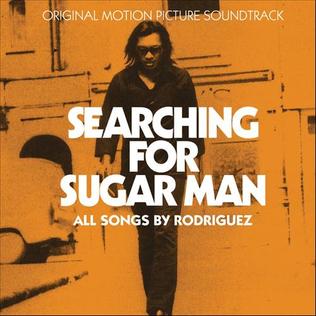
Sixto Rodrigues, an American musician released 2 albums in the 1970’s which bombed so badly that he landed up eventually in construction work.

However, as it often happens, 2 South African lads travelling to America found his albums, loved them, took it along to South Africa.

There the shared the music with friends and families leading to Rodrigues becoming a cult success in South Africa.

Eventually Malik Bendjelloul made an Oscar winning documentary on this phenomenon giving a second lease of life to Sixto.

Sebastian Mallaby, the author of Power Law, describes this as the ultimate example of how success begets success. A sort of 2 parallel world where you succeed in one while failing in the other ones.

How the network effect got created for Sixto when these South African men shared the album in their home country and without him knowing or even trying to create it.

Influences

Mathew Salganik created the Musiclab experiment in 2004.

Where he enrolled 14000 participants to download and listen to songs.

Participants were divided in 2 groups:

  • 1st group received additional information on number of times the song had been downloaded

Additionally, they were divided into 8 groups where they would keep getting additional information on what their group was downloading

  • 2nd group got songs with only song title and band names

The results were interesting

  • In the Group 2-where decision making was independent, the result was predictable, popular songs became more popular and unpopular songs were less popular
  • However, in the Group 1, while the popular songs never did very badly and the unpopular songs never came out on the top, literally anything else was possible.
  • The success of the song depended upon its ranking along with its quality

Success begets more success and so can failure

Think of a movie director whose first film becomes a big success.

Take M. Night Shyamalan for instance.

Sixth Sense was a big hit, nominated for 6 Oscars including one for best director.

Everybody expected big things from him.

He was compared to Steven Spielberg.

But then it all became too predictable and coming to a situation where these days his name is not even being mentioned on the marketing material of his films.

What the makers are trying to avoid is exactly what the Musiclab experiment achieved.

If his name comes up, scores of people might opt not to even watch the movie expecting the predictable even though he positioned himself for unpredictability.

Without his name the movie might make big dollars which let’s say “The Last Airbender” did.

Social Influence or the Herd Tribe

Change can happen in 3 ways

  • By Rational argument
  • By Force, or
  • By Influence

Think about investors investing basis Reddit forums or taking tips from family and friends.

The comfort of doing something which someone known to you is already doing makes you skip the hard work that goes into a decision.

So, while you avoid the hard work and feel happy knowing you are doing what some or lot of other people like you are into, you could lose time, money and get stress in bargain.

The network effect can be good when trying to grow a business or even creating s social movement around a worthy cause.

However, whether it is about buying a product, investing in a business, or participating in a social movement, your own thought process, rationale and objectives should be in place, lest you become the “Sugar man” yourself-failing in one place and succeeding somewhere else purely randomly and not by design.

Of-course there can be no design, if you didn’t even make an effort to design.

By the way there is nothing wrong in getting influenced, till the ultimate decision has your finger-prints on it.

Thank you for Reading

Follow my Twitter handle @manver1974 for more such shares
Get Out

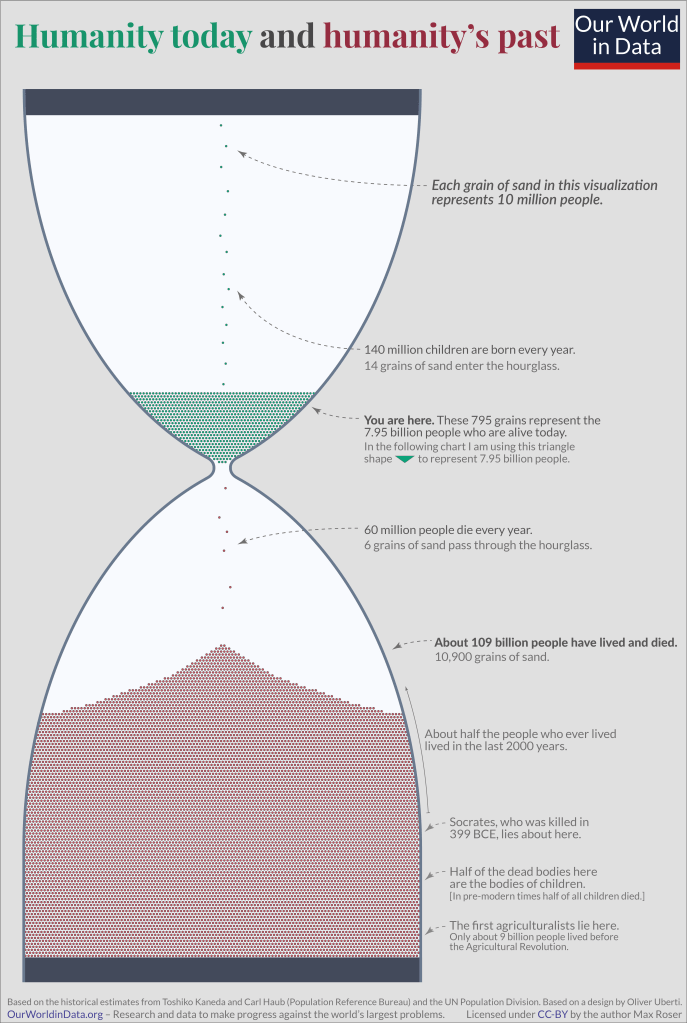
In his amazing essay on “Long termism”, Max Roser posits

“How many humans have ever lived?”

Demographers Toshiko Kaneda and Carl Haub have tackled the question using the ​​historical knowledge that we do have and as per them, considering a 200,000 years deadline when first humans came into existence, about 109 billion people have lived and died.

Past Created the Present

We are an outcome of all of these people’s struggles, efforts, experiments and achievements that we are bearing the fruits of.

The 7.95Bn people alive today constitute only 6-7% of the total humans that have walked the world ever.

Evolution

Think about the evolution of language, Some researchers claim that it happened in a single leap, creating through one mutation the complete system in the brain by which humans express complex meanings through combinations of sounds. These people also tend to claim that there are few aspects of language that are not already present in animals.

Other researchers suspect that the special properties of language evolved in stages, perhaps over some millions of years, through a succession of hominid lines.

In order to achieve a large vocabulary, an important advance would have been the ability to ‘digitize’ signals into sequences of discrete speech sounds – consonants and vowels – rather than unstructured calls.

Unrecognised

A large part of the evolution remains unrecognised.

When those, like Socrates, Plato, Aristotle, Confucius, who are still remembered today even after 2000-2500 years, were born, a large part of the basic structure was already in place.

So what we have in terms of history is a very small fraction of the 200,000 years since humans have inhabited the earth.

The number of people who are remembered even today in this 2500 years history are actually a very small fraction of the total that was born and lived through the entire history of human kind.

Maybe around 100,000 and no more (that’s just a guess).

Some Questions

How many of these people do you remember?

What do you remember them for?

How many of them contributed to how we think, talk, behave or relate to the world?

Today we have them as a reference point, what were their reference points?

What Differentiated this small minority?

Leonardo Da Vinci was enamoured now just by the art of painting but even by its craft.

He is remembered even today for how deeply he worked on displaying the human anatomy on the canvas.

To learn about human anatomy, he actually dissected and studied over 1000 bodies and the result is evident.

What’s the Key here?

Just reading this opens your mind to the differentiating factors:

  • A sense of curiosity that goes beyond the basic
  • An effort to genuinely satisfy that curiosity
  • Make an attempt to excel and now just finish a task
  • Driven not just by the outcome but by the process

It all sounds basics, however you realise that not many practice any of this leave aside all of it and that’s possibly the reason that only a very small fraction of people are remembered through the history rest all gone unnoticed.

It is also possible that as a large part of this history was spent by people struggling to survive, not many had evolution as a priority and your priorities do define your outcome.

Simple-Yeah

A recent survey revealed that buyers spend 11 hours researching a car purchase compared to 1 hours obtaining a home loan.

That’s the priority.

I can bet my bottom dollar that most , if not all, investors spend even less in taking an investment decision and then repent the losses.

The objective is not to make everyone great enough to be remembered.

The objective is to use the reference points from the greats in history to be able to make important decisions in a manner that’s logical.

______Happy Reading_______

Follow my twitter handle @manver1974 for more such shares
What Survives?

In his book “Rise & Fall of Dinosaurs, Steve Brusatta tried to visualize the day that led to the extinction of the “Dinosaurs”.

“WHAT HAPPENED ON that day—was a catastrophe of unimaginable scale that, thankfully, humankind has never experienced.

A comet or an asteroid—collided with the Earth, hitting what is now the Yucatán Peninsula of Mexico.

It was about six miles (ten kilometers) wide, or about the size of Mount Everest moving at a speed of around 67,000 miles per hour (108,000 kilometers per hour), more than a hundred times faster than a jet airliner.

When it slammed into our planet, it hit with the force of over 100 trillion tons of TNT, somewhere in the vicinity of a billion nuclear bombs’ worth of energy.

It plowed some twenty-five miles (forty kilometers) through the crust and into the mantle, leaving a crater that was over 100 miles (160 kilometers) wide.”

What survived?

‘Plants were less affected than animals because their seeds and pollen can survive harsh periods for longer.

After the dinosaurs’ extinction, flowering plants dominated Earth, continuing a process that had started in the Cretaceous, and continue to do so today.

But all land animals weighing over 25 kilogrammes died out.

‘What we’re left with are basically the seeds of what we have today. Many of the major animal groups that are alive today were in place before the asteroid impact and they all suffered some level of extinction – but the lines that led to modern animals got through’.

Why didn’t the Dinosaurs survive?

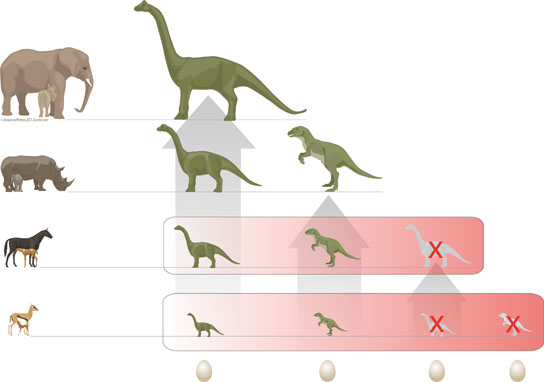
The most significant thing about dinosaurs was their very large size and very few species, unlike mammals, with several different species with different size and structures.

Dinosaurs laid eggs. Now eggs have a constraint on size given larger eggs require a thicker shells and embryo needs to be supplied oxygen through the shell thereby constraining how thick it can be.

This led to young ones being smaller than their parent. Parent being 2500 times heavier than the baby.

This means that they were competing not only with their own types but also with larger mammals and also they were larger than any other species in every growth stage.

As all the large species went extinct, dinosaurs with no medium or small variety were destroyed completely.

Now diversity could have helped them survive, the way it worked with mammals who were smaller size at the time of dinosaurs extinction and developed into larger species as evolution happened.

Diversity has an advantage

Genetic diversity helps a specie adapt, evolve and survive.

For example-Populations of wild cheetahs have very low genetic variation. Because wild cheetahs are threatened, their species has a very low genetic diversity. This low genetic diversity means they are often susceptible to disease and often pass on lethal recessive mutations; only about 5% of cheetahs survive to adulthood.

Survival needs adaptability & Evolution

If you need to survive, life or even investing, that is my key area of interest, you need to learn adaptability and evolution.

Investors jump headlong into markets when things are rosy and then panic exit when things turn awry.’

These same investors who have lost money in markets either get so scared that they abandon the idea of investing till the next tidal wave of market high appears or start thinking of markets like a casino, going away never to return.

The challenge in both entering, panic exiting and then coming back still doesn’t show adaptability and evolution.

How do species adapt?

The long necks of giraffes for feeding in the tops of trees, the streamlined bodies of aquatic fish and mammals, the light bones of flying birds and mammals, and the long daggerlike canine teeth of carnivores.

The adaption doesn’t happen by being part of the herd but by developing abilities to channelise the learnings of each experience into how you will face the future and how will you make a decision to deal with a situation next time.

Evolution can’t happen if reasons for failure are outside and attributes for success are your own.

Evolution happens by being humble, reflecting on your experiences and learning from them and not by running away.

Hopefully next time the readers shall keep this in mind before taking a decision on how to approach the markets.

Fetch Rock

Playing “go fetch me a rock” is a favourite time-pass for clients and managers.

You are asked to produce something with little or no details and no specific goal.

When you accomplish the task, the response is this is not what was required you are sent on another wild goose chase and this goes on and on.

It’s like “go fetch me a rock, no this is not the right size, get a bigger one, no this is not the right shape, go get me a different shape and so you rock-fetch, rock-fetch & rock fetch….

It’s a pointless, useless activity that just keeps people occupied without achieving anything and frustrates the hell out of people.

“Unfair”

It seems unfair when someone makes you fetch rocks likes this, isn’t it.

However so many of us don’t realise how we spend so much time fetching rocks ourselves without paying attention to what’s happening.

In India mythology, when Lord Hanuman was asked to fetch a certain herb with medicinal qualities and he couldn’t differentiate between the various herbs that were growing on the mountain from which he was supposed to get them, he picked up the entire mountain and got it, or so goes the story.

Well, at-least he knew he needed to fetch the herb even if he couldn’t identify the right one so he did what he thought was best.

However when you don’t know what you are going for, you spend a lot of your time on meaningless/pointless activities that are akin to “fetch-rock”.

End of the day, “fetch-rock” is like walking without a destination in mind and as they say “ if you don’t know where you are going, then you are Alice in Wonderland.

Simple to Complex

For generations, investors were used to getting steady yields in their fixed income portfolios.

There were pension benefits, bank deposits used to provide a good yield.

Life was simple.

You could be a saver and sail through.

You really didn’t need to identify how much you needed, things were simple.

First there was pension and if that was not enough, your bank deposit would make up for the shortfall.

No complex equations were required.

You had not need to think about investing.

It was not a necessity.

Over the last decade or so things changed dramatically.

Inflation got reined-in.

Interest rates dropped.

Savers used to stability were caught unawares.

Suddenly no rules applied anymore.

Follow the “Rabbit”

As the rabbit of low rates kept moving deeper the financial wonderland took investors on a fantasy trip.

Now you had to make decisions that you are not prepared for.

You don’t know what you need to achieve.

There is excitement as well as fear of the “unknown” and the financial roller coaster gives you the ride of the lifetime.

The excitement of equity markets overshadowed the objectives and suddenly people were all over the place.

The roller-coaster made emotions jump up & down and all people ended up doing was “fetch rocks”.

Jigsaw Puzzle

The question is are you in it for the “excitement” or for a purpose that is no longer fulfilled by the simple saving methods.

The “excitement” of the rise makes people often forget the purpose.

It becomes then a classic “rock-fetch”.

The jigsaw puzzle has a purpose and a method.

However if you randomly try to construct it, you can never put it all together.

There is good news

The good news is that this “rock-fetch” is in your control.

Like everything in life-for example studying to become a professional (doctor, Engineers etc.,) doing a business or job to find meaning and also making some dough, investing needs to have the defined goal.

Once the goal is in place, you will be fetching lesser rocks while solving the jigsaw successfully.

So defining a purpose and a goal as you see is critical not just while dealing with a boss/client or some other power but even in how you lead your life.

——————– HAPPY READING———————–

Random

Till the cricket world cup hosted by India, Pakistan, and Sri Lanka in 1996, host country had never managed to win the cup which had always been won by the team batting first.

Both these myths were broken as Sri Lanka, one of the host countries won the cup handsomely batting second.

India never loses to Pakistan in a Cricket tournament organized by International Cricket Council-a myth broken in 2009 and since than Pakistan has defeated India in ICC tournaments thrice.

Paul the Octopus who even though predicted only 4 out of 6 matches correctly in the 2008 UEFA cup was considered so highly that he was used in the 2010 world cup again where it ended up predicting all the winners correctly.

The reason I am listing all the above is because these are just random events that happen without any correlation to each other and where the outcome is considered the proof of the evidence.

Just the way “Absence of evidence is not evidence of absence”, just because few successive events randomly without any correlation happen successively doesn’t mean they are indicating a pattern.

Gambler’s Fallacy

When an event or series event occur multiple times close to each other people tend to create co-relation believing that their future occurrence is more likely or less likely to occur. This is called the Gambler’s fallacy.

Investors often commit gambler’s fallacy when they believe that a stock will lose or gain value after a series of trading sessions with the exact opposite movement.

For example, consider a series of 10 coin flips that have all landed with the “heads” side up. A person might predict that the next coin flip is more likely to land with the “tails” side up. However, if the person knows that this is a fair coin with a 50/50 chance of landing on either side and that the coin flips are not systematically related to one another by some mechanism then they are committing the gambler’s fallacy.

The most famous example of gambler’s fallacy occurred at the Monte Carlo casino in Las Vegas in 1913. The roulette wheel’s ball had fallen on black several times in a row. This led people to believe that it would fall on red soon and they started pushing their chips, betting that the ball would fall in a red square on the next roulette wheel turn. The ball fell on the red square after 27 turns. Accounts state that millions of dollars had been lost by then.

History Doesn’t repeat but it rhymes

History doesn’t repeat itself but it rhymes is a cliché.

In the markets history does repeat itself but there is always a twist that makes it different.

The whole cycle does play out but each time there is an angle that has probably not been experienced before lulling even the most experienced, leave aside the newbies into a comfort zone that prevents them from getting trapped.

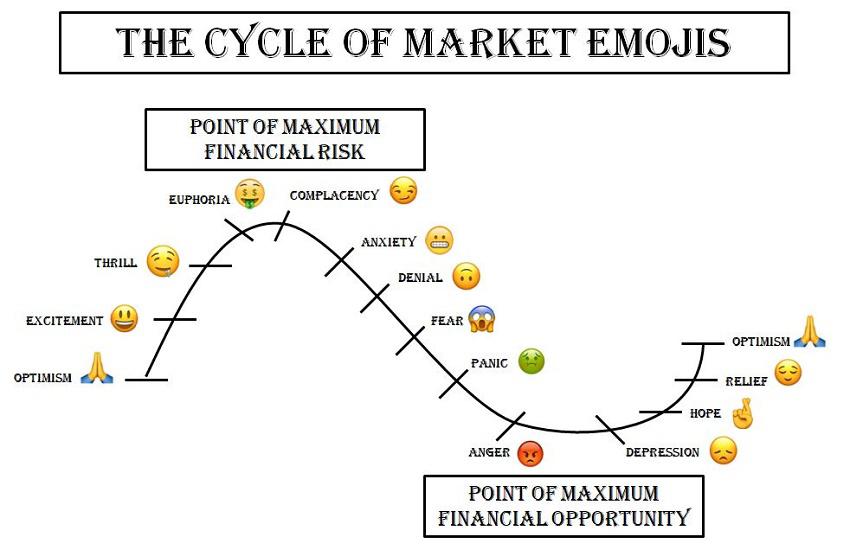
The cycle looks something like this:

Courtesy “Forbes”

What’s the Key?

  • Keep your focus and goals up front and centre
  • Stick to your risk-profile
  • Understand new opportunities and experience them with a small (5%) or so of overall allocation), if you want, to avoid both regret and loss minimization and also be able to take a bigger call or avoid the opportunity next time basis this experience.

It will also give you the ability to evaluate another opportunity in the future

  • Markets behave like a “spring”, they bounce back with a vengeance even if it takes time to bounce.

Take advantage of accumulation when markets decline or stay flat so that the “spring” effect plays out and you can achieve your long term goals

Ultimately “Stay the Course”

Follow my twitter handle @manver1974 for more such shares

DRY

Our personality traits go a long way in shaping what we are and what we become.

Success in what we do can be measured in several ways-both quantitative and qualitative.

However to my mind the main criteria is amount of satisfaction that you derive from what you accomplish.

The satisfaction bit is also a fall out of how passionate am I about my endeavours or is it a mechanical exercise where I go about my work like a machine.

Our personality traits play a large role in defining our approach to our endeavours.

What’s Your Personality?

It’s one thing to have a passion for multiple things for example but it’s a completely different thing to be good at all of them.

This is the category of people known at “multipotentialite”.

A  multipotentialite is someone who can attain high level of competency in multiple subjects

They are curious, can think on their feet, carry out and enjoy challenging tasks and work independently.

Where does this train come from?

Paul Costa and Rob McCrae through their research discovered that most human character traits can be described using five dimensions as listed below:

  • openness to experience– measures cheerfulness, initiative and communicativeness.
  • Conscientiousness– measures a person’s degree of organization
  • Extraversion– People with high scores here love novelty and are generally creative.
  • Agreeableness– describes how we deal with others
  • Neuroticism– measures emotional stability

Multipotentialites are perhaps a mixture of openness to experiences and extraversion.

This is important to appreciate.

The Good & the Bad

Each of these traits have their up & downsides.

Passion is the lead to learning.

Learning requires a certain kind of openness to experiences and people that helps you derive the maximum from whatever you undertake.

Fortunate are the people with resources and freedom to experience.

Believe you me it’s a luxury, however, then they encounter the hurdle of their own personalities that stops them from taking advantage of the resources at your disposable.

DRY Personality

Someone who is very conscientious but not very open to experience or extroverted may come across as having a dry personality. 

If you don’t show a lot of emotion, don’t find many things funny, and are particular about the way things should be done, you might have a dry personality.

These are hurdles to learning that often people don’t appreciate enough.

50% of who we are is driven by our genetics but the balance 50% is our environment that’s something we can shape.

Often you see people from less privileged background breaking new ground while those with all the resources struggling.

Believe you me it is not genetics at play here, instead it is what the privileged environment does to you that can be at play.

Openness to experience need humility and often humility is the first casualty of a privilege background.

If you get used to demanding instead of doing, learning will get restricted.

Is there a Solution?

You are your solution.

  • Things are going fine, I don’t need anything else.

Well you will never know your limits unless you challenge the status quo.

  • Accept who you are. Whether you have a mediocre background or a privileged one, your desire to excel is important and not your background.

Background makes it easier as you get resources but it can’t give you passion

  • Be humble, it is not necessary that only those above you in status or a consultant will provide you the learning or experiences, even those below you often have the ability to teach you things.
  • Review your standards of excellence. Excellence has no parent, institution or class, it comes from passion that is individual
  • Be Open and communicate
  • Be Interested in people. Talk to people not just and below/above but humans

Of-course there could be several other things that you could do but the key is to get more involved and patient and see the results.

I come across so many people who want to

  • know about the world but don’t want to read
  • learn to play a sport but won’t go to the stadium
  • learn to invest but haven’t even tried starting

The idea is not just to listen but even to do.

And doing requires work.

Start Today

MOOD

What motivates people daily is one of the most difficult things to predict.

You can either be rationally committed to your work, family, friends, life etc., etc., or emotionally.

A rationally committed employee is for example exchanging his time for the organization’s compensation for it.

An emotionally committed person on the other derives a higher purpose from the association and have a passion not just for the work but also for the organization.

The Times of India recently highlighted the case of a techie who was working for 7 firms simultaneously thanks to work from home.

It was only discovered when HR manager of one of those firms while verifying his Provident Fund (PF) account discovered multiple active PF accounts.

Clearly this person was not looking for a higher purpose.

He was exchanging his wares for money.

Emotional commitment is a positive to the recipient of the commitment whether organization, family, or friends.

The Other side

Emotions create attachment and attachment creates expectations.

End of the day whether it’s an organization or a relationship, there is a give and take.

As Stephen Covey writes in the “7 Habits of Highly Effective people”, relationship “give & take” is like entries in a passbook.

When you deposit 100 dollars in the bank, it reflects 100 dollars, however in a relationship, you 100 dollars could be more and sometimes less than 100 dollars depending upon how much value the recipient attaches to your relationship gesture.

This creates dissonance and frustration.

Emotional Commitment in Investing

There are ways to resolve the dissonance of such emotional disconnects when dealing with people through dialogue and understanding.

However, when investors have to go through such disconnects it causes serious heartburn.

Many investors make an emotional commitment along with a financial one when they invest money in the markets. This is particularly true for high-asset investors, retirees, and investors whose main goal is to preserve rather than grow their funds.

A gallup survey in United States found something startling:

“52% of the investor admitted to mood swings caused by the daily state of their investment portfolio”

The challenge is emotional commitment.

I wrote a couple of months back how investors get seriously invested into their portfolio beyond the financial commitment.

The urge to come daily and show case the success of their portfolio to everyone and how they are the genius who found the next big thing before anyone else etc., etc.,

It is a vicious cycle, and it is easy to get caught up.

What should the investors do?

First thing first remember that your portfolio doesn’t know you are invested into it and has no emotional connect with you.

You are having a one-sided affair.

Like everything else in life, it is difficult to get disciplines about investing.

Whether its education, how you do your work, your fitness, excellence requires a certain degree of discipline.

Your disciple in not getting too attached to the portfolio’s outcome on daily basis is a practices art.

The consistency in your thought process is a practiced art and something that needs to be developed.

Stock market will go up and down, but your mood doesn’t have to.

Here are 2 thoughts to ponder on:

  1. It is fair that not everyone will have the same skill set to make investments, and as a 1st step admitting your actual competence level and keeping things simple will help.
  2. As a 2nd step, whether a gym, or workplace or studying, people have a buddy that makes it easier to study, workout or work with disciplines, hence having a buddy, mentor or advisor who can calm you down and help you practice disciple can be very valuable.

To reiterate, it’s not easy but then when was life easy.

Learning to enjoy the fruits of life at leisure is a luxury but one that you can develop with practice

All the best

Commitment

Odysseus (known as Ulysses) was the king of Ithaca.

After fighting the war against the city of Troy, he started his journey home.

During the sea voyage, he was confronted by the sirens.

The sirens were dangerous characters in Greek mythology who would enchant voyagers with their enchanting voice and get their shipwrecked on their island.

Ulysses wanted to be able listen to the sirens while making sure that he can escape the shipwreck.

So, he entered a pact with his men.

According to the terms, it was agreed that his men’s ears would be plugged with wax, and he would be bind to the mast of the ship and whatever he says, no one would release him till they have sailed past the siren’s island.

The wax will make the men immune to the siren’s voice enabling them to sail past successfully.

The twentieth century behavioural economist used this story to create an “Ulysses pact” also otherwise known as the “Commitment device”.

The idea is to bind yourself today in to a choice that would lock you in from a future action.

Essential but Difficult

Most of what’s essential in life is also very difficult to achieve as temptations abound in our path of achievement.

Think about ensuring that credit card bills are paid on time so that you avoid the usurious interest rates or eating healthy to avoid getting fat or disease etc.,

There will always be the temptation to use the extra cash to buy a new phone or to eat a sweet/fried snack because you are just too tempted.

Setting up an autopay in your bank account on the day of your salary credit or avoiding keeping fried snacks/sweet at home are examples of a Ulysses contract.

Behavior Management

Stephen Pinker in his book “rationality” describes the Ulysses story as Ulysses having surrendered his ability to act and his sailors’ their option to know.

While this might sound irrational, in investing this applies perfectly.

Putting wax in the ears, means focusing on your objective and destination by

  • Avoiding the noise
  • The daily market movements
  • Avoiding checking daily valuations,
  • Resisting the temptation to look at the hot theme or the hot pic.

Keeping focus on your fundamental investing objective and quality of your portfolio on a pre-defined periodicity is like checking the compass to ensure that you are on the right path.

For the rest “Use Wax”.

Long-term investing is more to do with “inaction” than “action”.

Tying yourself to the “mast” means it should be difficult for you to act.

  • Not keeping online access to your brokerage account
  • Not maintaining watchlist on Bloomberg or moneycontrol might help you go in the right direction.

This doesn’t mean ignore reviewing your portfolio.

All it means is that you don’t have to do it every minute of your existence.

Sticking to reviewing portfolio only on pre-defined periodicity is all you need.

Investing is about avoiding bad decisions and the less you act, the better your chances at achieving that.

In football, when a penalty kick is being taken, the best position for the goalkeeper is in the Centre.

A study of over 575 penalty kicks in football, threw up ma very interesting observation, in over 85% of the kicks the goalkeeper made a move under the pressure of being seen to be doing something instead of standing still and acting once the kick has been taken.

Just what you need to avoid gets done.

Maybe the goalkeeper also needs a commitment device

So, bottom-line, “Use wax” and “rope” for investing success

Realization

A recent blog by @morganhousel titled “Fluke” made me think and inspired this write-up.

The author talks about how circumstances conspired to make him what he is today, the story that he shared with kids at a school recently.

Come to think of it,  was it really a fluke or just a discovery mechanism.

In the Indian religious epic “Ramayana” we read the story of how Lord Hanuman was reminded of his powers to fly.

While still a baby, Hanuman, the child of a nymph by the wind god, tried to fly up and grab the Sun, which he mistook for a fruit. Indra, the king of the gods, struck Hanuman with a thunderbolt on the jaw (hanu), thus inspiring the name. When Hanuman continued to misbehave, powerful sages cursed him to forget his magic powers, such as the ability to fly or to become infinitely large, until he was reminded of them.

During the search for maa Sita the time came to cross the ocean, Jamavanth said among them Hanuman is only able to cross the ocean and reminded him how he was born of Vayu (Air) and possess special powers. After the reminder the curse broke and His powers again increased.

Sweet Accidents

Getting something unexpected and nice can happen.

The key in life often, however, is not about the gift that you got accidentally but to know what to do with the gift and that is not accident.

Whatever you like to call it, the “it” factor or the “x” factor or competence, that’s inherent.

A sweet accident might just give you the opportunity to use it and make the most of it.

 In the recently concluded Ashes (between England & Australia, for those uninitiated in Cricket), Usman Khwaja, got to make a comeback to the Australian team only because the regular opener, Travis Head tested positive for covid.

He struck centuries in both the innings of the match making the most of the accident that put him back on the pitch.

A “Fluke” that’s me

The reason I could relate to the author’s story is because it reminds me of how I started my journey towards what I do today 17 years back.

My then boss was responsible for getting the Financial Planning Standards Board granting the “Certified Financial Planner” certificate to India.

For whatever reasons or maybe he saw my time as most expandable, he told me to represent on the board and the education committee of FPSB.

When I went for the first meeting, I had no idea what is “Estate planning”, however given the young age and the enthusiasm to not fail at the task, I started learning and hence began my journey to be a “Family Office Manager” today from being an HR Manager then.

Yes, the opportunity was a “fluke”, however the ultimate outcome, I don’t believe was a fluke.

Unless I had the interest and dedication to do a good job, it would not have worked out giving me an alternate career that I love.

So the “realization” that I can do justice happened because of “fluke” but I guess you need the fluke to open your eyes to possibilities.

I am happy today that the “fluke” happened to me.

Thank you for reading