Should you follow “Influencer Investing”

https://economictimes.indiatimes.com/tech/startups/online-brokerages-invest-in-financial-influencers/articleshow/82919503.cms

Here is a story on how some online brokerages are using social media influencers.

One of the good things about investing is there is no right or wrong.

What works for you is right for you.

So, checking out some of these influencers you can see the audience for which it might work.

What kind of advice are you looking for is also very critical aspect to consider.

How does it work?

Academics will teach you that there are 3 methods to change behavior:

  1. Dictate change-works for a while but doesn’t make every lasting change
  2. Argue change-you might win the argument but not the change
  3. Influence change –
    • There are individuals around everyone who are either respected, envied or competed against.
    • These are your influencers by design or not.

Is it Healthy?

As a marketing technique it is great to create an influencer campaign.

It might even convert into business.

Remember “Influencers” are there for a reason.

They give you comfort and sense of relatability.

Like with everything understanding how you use an influencer and who is the right influence can help.

When you deal with someone who doesn’t have the background to understand technicalities of financial investing, the whole idea is to simplify the campaign.

“Simple” and “Simplistic” are separated by a fine line.

It is always easy to take one part of the equation and amplify it.

However, financials decisions are about setting the context right.

Now that is time consuming, and no IGTV/Reel’s content can do justice.

 The easiest route then is to dish out simplistic advice and product pushing.

There is a PR element to every company that helps it be seen as an ethical/interested in customer well-being/communities etc., kind of company, and then

There is real business to be done.

I would love to have consultative sales process, unfortunately it is too time consuming and expensive so go and do the easy thing to push products.

Influencers come handy here.

Is that the kind of Influencer you want to follow?

Easy Way Out

Individual investors as we have discussed earlier have a complex relationship with investing.

It is also driven by the same factors that create influencers.

  • X person invested in so and so, which did well so I should also do the same
  • X person has made so much money is Y investment, I am more intelligent than s/he, I will also do that same

Remember this:

As an investor one is looking for easier answers and simpler ways to take a decision, however investing is serious business.

You will get the easy answers and simple ways after putting in the effort.

It’s like once you learn driving it seems simpler but till you do, you are scared to touch the wheels.

Now serious investing takes efforts at understanding

  • Yourself
  • Your financial needs
  • Your ability to take risk
  • Your time frame
  • Take the effort to Understand what you are investing in and what are the risks associated (and don’t’ say I will not invest in what I don’t understand)

Tough ask, so what’s the easiest way out.

Be a Follower.

Should you be a Follower

Being a follower in social, professional, religious or politics is driven by beliefs or needs.

However, in investing the leader and follower might be playing completely different ballgame.

The leader’s knowledge, ability to understand risk, margin of safety, timing, information network, liquidity and timing of exit are neither known to you in advance nor on your horizon.

By the time you realize something has been done by the leader, the “ship might have already sailed”.

However if you have answered all the questions listed above, you might be able to differentiate between the applicability of what an influencer is saying for yourself and that’s really where you wish to reach.

There is no shortcut

Yes, you could track and listen to the influencer and their moves but remember “investing is not one size fits all”.

You need a guide who can put what you need, you listen into the context of your circumstances.

For ideas/guidance contact on manish.verma@manishverma.co.in +919920741569

Follow my twitter handle irreverentinvestor @manver1974
Regret

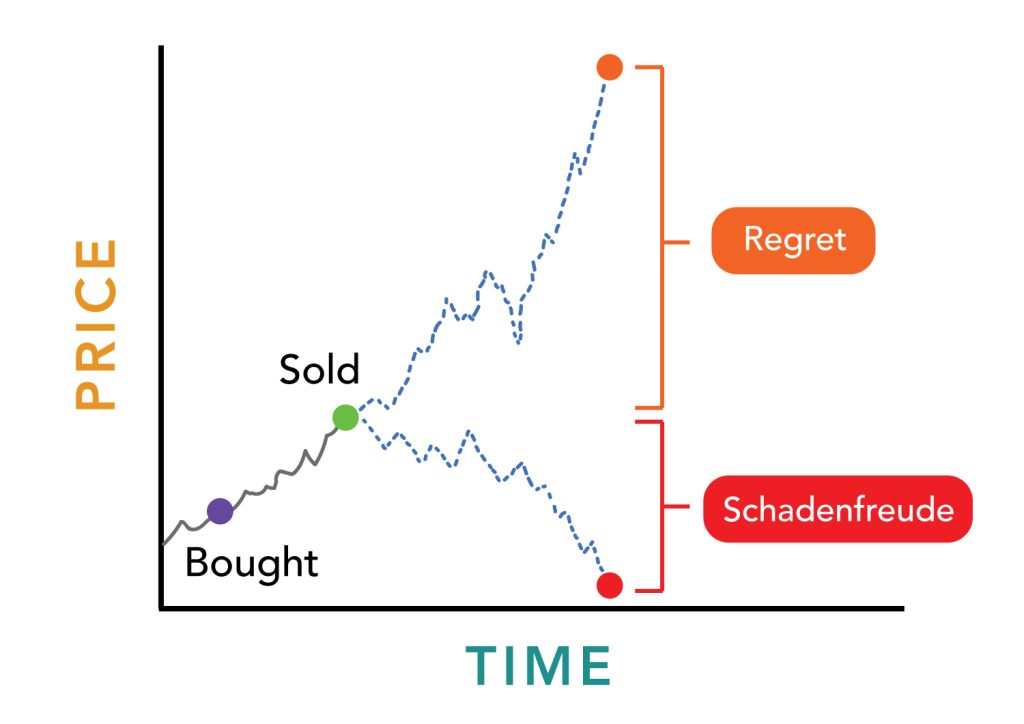
Regret theory talks about how people anticipate regret when they make the wrong choice and how that plays on their mind when taking a decision.

At times this fear can paralyze action and make people take irrational decisions.

Legendary investor Perter Lynch often cited CML Group as a regret.

He had experienced their products personally, he knew sales were rising.

He had 2 trusted analyst tell him that the company is doing well and should be considered for investment.

However he had a nagging doubt that prevented him from investing.

#Universal Experience

When Warren Buffett first bought a stake in Berkshire Hathway, it was a failing textile company. He saw an opportunity in closing mills and bought a large stake.

A few years later the manager of the company offered to buy back the shares from Buffett, however the offer was too low which got him so angry that he fired the manager and ended up becoming majority owner of a failing business.

Buffett has estimated his losses from this purchase to be to the tune of 200 Bn USD.

#FOMO & FOBI are Like a Pandemic

In March, 2020 most investors had FOBI (Fear of Being In) and today they have FOMO.

Those who sold then found it very difficult to get in which is almost always the case.

In 2020 we saw what’s called a classic “sector rotation”, first came FMCG, then Pharma and then Tech and then something else.

It was exhausting for investors.

Just as you thought you got it right, something else started working and where you invested lost momentum.

#Are you up for the ride?

Our experiences make us who we are.

You don’t suddenly grow up into a confident smart adult.

You go through series of experiences, good, bad and ugly and a product of that is what makes you what you turn out over “The Long Term”.

Investors have a short-term memory.

A good year makes everyone an expert;

A volatile year takes wind out of the sails.

Universally every investor says, “I am Long-term investor”, however when what they hold is not working, they either turn into “momentum chasers” or get massive regret.

This can have severe confidence crisis and leads to FOMO/FOBI.

It is a roller-coaster indeed.

#Core Issue

Lack of understanding.

I don’t tire saying this but investors need to know what they are getting into and why.

The lack of understanding (which is understandable when that’s not your area of expertise) leads to decisions based on tips, half-baked ideas and finally regret.

#What should you do?

Every day we try to incorporate work, family time, relaxation, work-out, entertainment.

Now different people have different idea on how each of the above will work, but it is taken care of nevertheless.

So have a plan that incorporates each of these needs/factors/emotions that you need taken care of in your allocations.

Always remember discipline of investing rather than chasing returns will have more stable outcomes.

Are their ways to incorporate each of the above in your portfolio.

Yes there is.

There is no short-cut to success and don’t even try to look for one.

For ideas and guidance contact on manish.vermas@manishverma.co.in or +919920741569.

Follow my twitter handle- irreverentinvestor @manver1974

Relationship With Money

People have complex relationship with money.

The push and pull of decisions that should be rational and choices that are emotional makes life difficult all the time.

Depending upon how one is positioned emotions as wide ranging as fear, guilt, shame and envy can impact the rational of ones’ decision making.

Fear of not having enough, guilt on over-spending and even not being able to enjoy; shame of not doing the right thing and envy because of comparisons with others can make money choices very complicated.

Stage of life and priorities can also complicate the equation.

While the rational side of the equation tells us to save more, postpone consumptions, the reality is that Over 60% of Indians are spending 59% of their earnings on living expenses while over 51% admit to not even knowing how much money they would need in retirement.

Let’s examine this in detail.

There are 3 stages of money that an individual can experience:

#Scarcity

In a low capita income country, majority experience is scarcity of money.

Limited resources and limitless wants.

Children moving into adulthood and having experience scarcity tend to be like pressure cookers, they have been holding themselves back for too long.

Who doesn’t aspire for a nice phone, car, home etc.,

Frustration is a big part of this experience.

Daniel Kahneman in his new book “Noise” talks about how hunger impacts decision making amongst judges.

Hunger is the noise, and any kind of hunger suppressed for too long beyond the lunch time is bound to have negative consequences for human faculties to make a right/rational decision about money.

#Availability

With income or increase in income comes freedom.

However, if all that you experience through life is scarcity, what do you think will happen first, “savings” or “consumption”.

This phase has the most complex manifestation of emotions for an individual:

  • First comes heavy duty consumption, lot of money in the beginning of the month. No money around the middle till the end of the month

There are over 20 providers of loan against salary in India

This on top of “buy now pay later” plans on offer

You can imagine the vicious cycle

  • As people grow older, comes the circle of shame combined with guilt
    • I don’t have enough money
    • I spend too much
    • I don’t have a plan
    • I don’t have knowledge
    • I have not saved enough
  • Then comes the random advisories
    • Postpone consumption
    • Don’t’ buy coffee, make it
    • Don’t eat out
    • Cut-back

The vicious cycle can be a crazy ride

#Abundance

This is aspirational. Reaching here is a dream most find unattainable and for a reason.

This is where you want to reach but don’t know how.

You don’t reach here by cutting small expenses, take train instead of cab, make coffee instead of buying it but by discipline around your larger expenses.

It is the large impulsive/emotional spend that just takes the sail off your boat.

You can cut coffee for a whole year, but it will no match for a large unwanted expense.

Reaching abundance is hard.

It needs a coach, a guide, a specialist and whole lot of discipline around your relationship with money.

The idea is not to postpone joy out of your life for some uncertain day in future when you might/might-not even be alive but to prioritize your needs and wants.

When people diet, the dietician allows a cheat day, your consumption also needs a cheat day.

However, whenever the spend is going to be bigger than what you can afford, sleep over it and see if you still need it.

Sachin Tendulkar once said that when chasing a target he doesn’t keep it in from of him but at back of mind.

Keeping it in front puts too much pressure and restricts natural game.

If you think like that about your relationship with money, the ride might seem a bit more smoother if not easier.

Follow my twitter handle irreverentinvestor @manver1974

What Really Matters

2.75 crore cases, over 3 lakh deaths, I assume over 10 crore households urban/rural, poor/rich without any religious bias got impacted by Covid.

Last almost 15 months have been a watershed moment for almost everyone across the globe.

It changed how people looked at the world.

It was like one of those fantasy sci-fi coming true.

A nightmare for those directly impacted  and a source of fear for everyone else.

As lakhs struggled for help and lost their loved ones, a sense of gloom descended across the country.

On the flip side the pandemic was also an opportunity for people to assess what’s really important to them.

When times are good most of what really matters is our work (for most this is their only identity);

material well-being (acquiring more and more and making this an attachment of status)

The above 2 are used to create an image for the outside world while it doesn’t matters what’s happening inside.

A lot of literature and self-help books that people often read but seldom imbibe talk about

  • Sense of Purpose,
  • Control on our time,
  • Gift of health, and
  • Strength of our relationships.

Most of these are like religion/God or Spirituality that one us reminded of only during the crisis time.

3 things I believe have been opportunities stemming from the pandemic(The idea is not to generalise but present, it might not be equally applicable to all):

#Is there a deeper meaning in your work?

Over last more than 22 years of working life, one has met scores of people for whom a job is just that, a job. It has no meaning for them accept for it being a transaction exercise.

Covid actually made a lot of people realise how even a cog in the wheel has an important role to play.

Albert Camus’s classic novel The Plague. is about an epidemic, where the main character was a doctor,” he explains. “And he says the way to get through something like this is to be a decent person. Somebody asks him, ‘What makes a decent person?’ He says, ‘I don’t know but, for me, it’s just doing my job the best way I can.’

This is classic, when leaders wonder about lack of engagement in their staff, they don’t realise that most of them don’t have a sense of purpose.

The pandemic has been an opportunity to reassess the career and reflect on its purpose on your larger mental well-being.

Number of PR articles appear in Sunday papers on how organizations are addressing mental well-being.

Easy solution has always been mechanical(PR route), take the difficult road for once.

#Family Bond Re-set

A recent survey by the Telangana Information Technology Association (TITA) found out that Work From Home (WFH) is bringing the families together. The remote working is strengthening the bond between husband and wife. The survey reveals that 89% of techies reported enhanced relationship with families and spouses.

Surveys of-course need to be taken with a pinch of salt as the book “Everybody lies” by Seth Stephen proves.

We know people tend to give the right answer in the survey rather than the correct one.

Here are some trends from Google worth looking at though:

 16-1717-1818-1919-2020-21
Divorce453944.844.1749.6
  -13.33%14.87%-1.41%12.29%
Stress63.2861.9454.4462.3878

The good news is that very few searches for suicide in India, the bad news, in just 1 week between June 14-20, 2020, the search for suicide spikes to 100

Divorce searches spiked in 20-21 so did stress.

So while the survey tells us one things, the reality could be different.

The opportunity of more facetime with family seems to have resulted into different outcomes for families, however it can still be taken as an opportunity to build better bonds and maybe achieve the outcome of the Telangana survey.

#Health is Wealth

So many of us take our health for granted until we have a reason not to.

We neglect exercise and then wonder why our bodies complain when we need to climb a flight of stairs. We neglect our diet and then wonder when all this extra weight crept up on us. We neglect our mental health and then wonder why we’re always stressed.

We can be kinder on ourselves. We can add regular movement to our lives. Walking, the gym, bodyweight exercises, yoga—it all counts and can all be mixed up. Our bodies are made to move, not sit humped over laptops or in front of TVs all day. Embrace the ability to move.

While the pandemic has scared the hell out of a lot of people, it has also brought health at the forefront of these discussions.

The scars of pandemic will not go away easily

However as the things settled down, online fitness classes have zoomed.

Some of the fitness apps growing 10-times in size over last 12 months.

Retail health insurance grew 28% in FY-21;

Searches related to Health on Google spiked 30%.

I hope this remains one trend that people will not give up on easily.

Human being through history have been known for short-term memory and moving on.

While moving on from a crisis is a good things, one hopes some of these trends have had a deeper impact on human psyche and the positives will stay longer and be part of daily life.

Follow my twitter handle on irreverentinvestor@manver1974

Thundering Herd & The SMALL GUY

Mid 1900’s was a time when individual investors were the most prominent investors on wall street rather than institutions like Mutual Funds, insurance and pension funds.

Most of the large brokerages would use small time brokers to execute their orders, however it was Merrill Lynch that launched its network of financial advisors famously known as the “Thundering herd” who would execute trades directly for the investors.

However, over time as mutual funds and pension funds came into prominent, the institutional investors became the real thundering herds as they were the ones who were doing all the buying and selling.

In 1993, this is what Peter Lynch (famed fidelity Fund Manager) wrote about it:

“A sizeable faction of this Thundering Herd could even be called the Blundering Herd. I can say that with confidence, having ridden with the Blundering Herd on more occasions than I care to admit.”

Lynch goes on to say that the fact that professionals handle bulk on the money gives the individual investor an inferiority complex. However actually it improves their chance to make money if they can act contrarian to the Thundering herd.

2020 saw the return of the small guy in a big way.

In the United States it was driven by the phenomenon of Redditt and Robinhood investors bringing the hedge funds on their knees with “GameStop” and “dogecoin” investing leading the pack.

The same phenomenon that was driving retail investing in the US was seen in large numbers in India in 2020.

Sitting at home, nothing much to do, over 1 crore new investors opened broking accounts and started transacting.

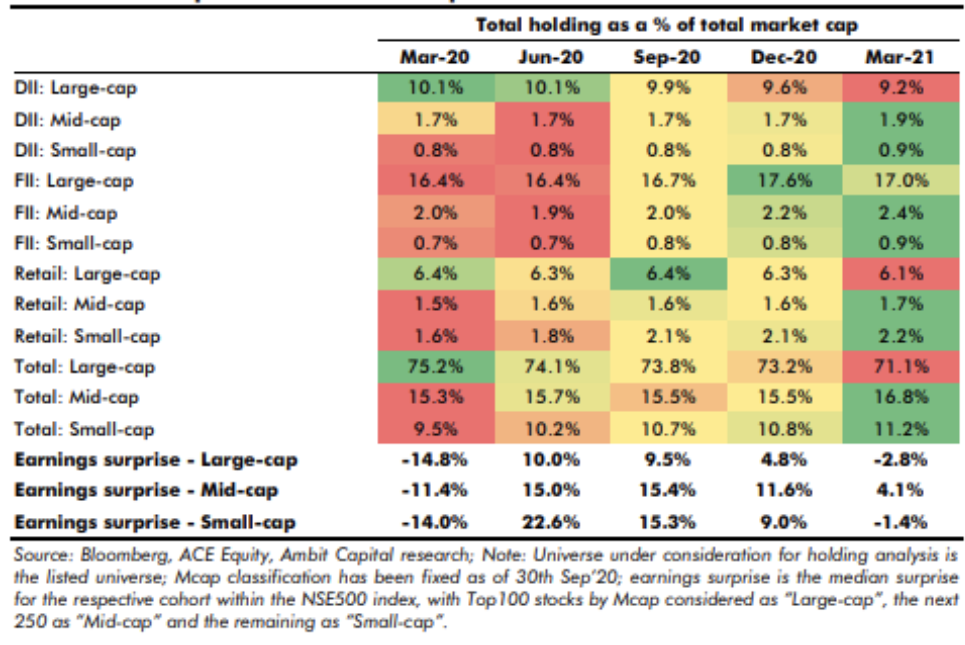
Between March-20 to March 21, retail ownership of equities went up by 5.25% from 9.5% to 10%. On its own it might not seem a large increase, however considering that India’s market cap went up by 1Tn USd in 2020-21, this additional 5.25% represents over 50 Bn USD or 3.5 Lakh Crores.

Retail investors especially the new ones had a great time last year thanks to the relentless rally and earnings surprises;

See here:

Almost the entire retail participation went up in mid and small cap where they experienced 4 quarters of positive earnings surprises.

Most of retail investors got the confidence that they can now manage money better than the professionals.

Let’s go back to Peter Lynch now.

He said individuals can benefit by the herd like movement of professionals.

Since he said this most of Fund Managers have also learnt their lessons.

However, in this rally what we saw was not un-herd like behavior from individuals but actual herd like behavior.

If gamestop and dogecoin are examples in the US, PSU names ae an example in India.

Most of the business channels have an advisory section where investors are asking advisors about what to do with their stock holding.

The crucial point that comes out of these discussions is that most investors didn’t have a good understanding of reason behind what they were buying.

40% of Nifty 50 stocks under-performed the benchmark over FY-21;

Of these 40%, 30% were PSU stocks.

Investors need to pay attention to some crucial points:

  • Getting lucky in stock market is not an everyday phenomenon and individual investors need to realize this.
  • If you would not buy a house, a car or a refrigerator without due-diligence and research, should you be investing your money without understanding what you are buying
  • While last year went well, have you got the tools to assess how’s your portfolio positioned for the next year
  • What can be earnings impact on your portfolio holdings of the 2nd covid wave
  • What are the long-term prospects for the businesses that you are holding?
  • After all of this what are your returns versus the benchmark

Even a professional Fund manager cannot claim complete understanding of every business that they own, for example there are hundreds of different chemicals being manufactured, can anybody claim complete understanding.

It is said that if you didn’t know how you made money, you wouldn’t understand why you are losing it.

There are no right or wrong answers in investing, however understanding what you are getting into is crucial to understand the risk and if you are up for it.

Follow my Twitter handle @manver1974

The 10-YEAR Irrelevance

Over the last 1-year investors in equities have experienced a virtual roller-coaster rise.

The markets went down over 35% in a matter of no time and them doubled from the bottom foxing several investors.

During this up and down, we got to spare a thought for the fixed income investor who has found nowhere to hide.

The part of the market perceived to be safe has no yields available while another part of the market, investors have been too scared to invest in.

This also has to be seen in the context of investors in AT-1 bonds of banks like Yes and LVB losing everything thereby creating heightened risk aversion.

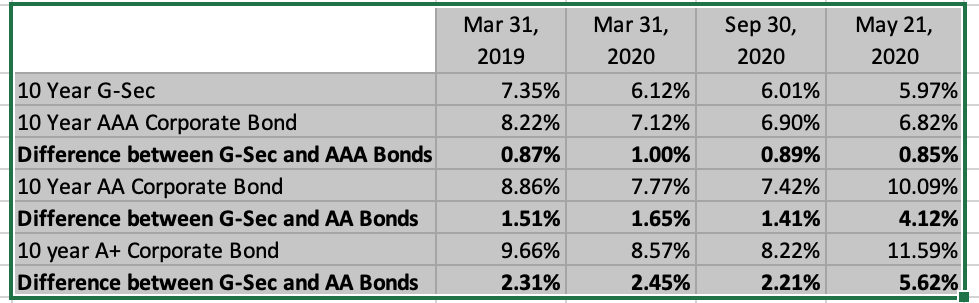
The heightened risk aversion can be seen in interest rates lower than the 10-Year Govt Security for the AAA rated companies.

In the meanwhile, the Reserve Bank of India devised a strategy to keep the interest rate that the Govt. pays on its bonds anchored to an artificial 6% yield.

Reserve Bank infact used every tool available in the arsenal to keep interest rates at or below 6%.

When the 2nd wave hit the country, this 6% anchor virtually rendered the 10-year govt security being used a benchmark irrelevant as clear from the data below:

While the yield difference between 1- Year Govt. Security and AAA bonds has remained steady, the yield difference between Govt. Security and AA/A rated bonds is not at all-time highs.

One of the reasons for the AAA yields have remained steady of-course is their safe haven status and the massive deleveraging in some of the large AAA entities.

However, the All-time high yield differential between below AAA securities and the benchmark 10-year GOI paper, raises a question mark on the 10-Year Govt. Security’s status as a benchmark.

This is also the time when a fixed Income investor should be looking to make the most of the situation to lock in yields.

As per Crisil default study 2020, here are the average default rates for AA and A rated bonds from the CRISIL universe of rated companies:

RatingNo. of Companies1-Year2-Year3-Year
AA280000.08%0.22%0.31%
A540000.21%0.90%1.76%

This extremely low default rate must give confidence to fixed income investors to take exposure to accrual funds of mutual funds to lock-in the higher yields.

Pandemic ensured that a lot of companies have already not only seen the worst but have even fortified their balance sheet on the back of some good earnings, debt paring and conservatism.

Infact the commentaries from major banks like HDFC and ICICI iterated that their corporate portfolios are less likely to default as 80-90% of the same is A or above rated showing the strength of companies rated A.

As per Mr. N. Sivaraman, MD, ICRA the expectation of large-scale defaults owing to the second wave are low and one of the reasons is how corporates have worked on raising capital and deleveraging in last 1 year to strengthen their balance sheets especially in the traditionally vulnerable sectors like commodities where pent-up demand has led to record profits even after deleveraging.

The anomaly created by this artificial anchoring of 10-year Govt. Bond by the Reserve Bank is a golden chance for fixed income investors who have been wondering lost for last over 12 months to play smart and fortify their asset allocation.

The Toll You Pay

Investing into equities is an emotional roller-coaster for investors.

Adam Smith (pseudonym) in his book “Money Game” write (italics mine):

The game of professional investment is intolerably boring and over-exacting to anyone who is entirely exempt from the gambling instinct; whilst he who has it must pay to this propensity the appropriate toll.

This toll is volatility.

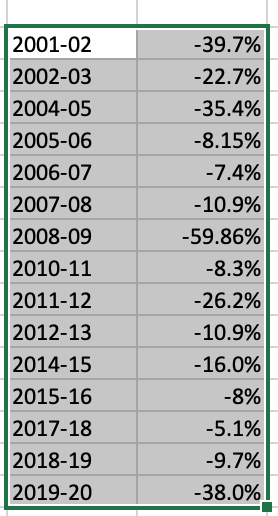
In the last 20 years Nifty 50 has delivered 12.3% CAGR (without considering dividends).

However, this table tells you a slightly different story:

  • Four times in last 20 years, the market fallen over 35%.
  • Twice it has fallen over 20%.
  • And of course, there have been multiple 10% plus falls.
  • These 35%; 20% drawdowns are not the only tolls that you pay.
  • There are multiple times, you will experience periods of flat to negative returns.

The gumption to go through these rollercoasters and to say ”Pay these tolls” will then reward you with the 12.3% CAGR returns.

Bitcoin fell over 50% in a matter of days. Yesterday it fell 30% in a day and then recovered 35%.

This is par for course for financial investing.

However, as Adam Smith writes in his book- “80% investors are not into stocks to make money”.

The gamification of investing involves emotions, thrills, chills and tears which makes it an irrational exercise.

This also is “Par for course” for investor behavior.

As an investor (while there is no taking away the emotions out of the equation).

The way you can think about this is to answer the basics:

  1. Are you investing to a plan?
  2. Why are you investing?
  3. How much risk can you take?
  4. What are you investing in?
  5. What is your investment tenure?
  6. What is your expected return?
  7. How much will you allocate to various assets?

And then if you really want to play the game:

“Have a small “Fun Money” allocation with which you can play the game and you might not mind losing”

The i-BOMB

Inflation at Wholesale levels were up 10.49% in April-2021.

Wholesale index includes- Primary articles (Food, Non-food, Mineral and Crude Oil) at 22.62%; Fuel (LPG; Petrol; HSD) at 13.15% and Manufactured Products (64.23%).

Here is an interesting chart from US which shows where the inflation from US came from in April-21:

Clearly the most depressed sectors of the economy namely airfares auto both sales and rental are leading the bounce back in inflation.

What’s happening in India though:

This massive increase in inflation came at the back of a negative 1.57% inflation in April-20.

The largest increase by the way came from fuel (20%) which actually is a fairly controllable item if the government so decides

Again remember in April-2020 oil sellers were paying you to buy oil as Oil prices went negative.

The soft base can continue to playout through 2021 as evident from the data below:

Month-on-Month inflation data

.At WPI level inflation didn’t become factor till Mar-21 when the base effect started playing out.

In Mar-20, everything went under lockdown, economic activity stopped and prices fell not only due to lack of demand but expectations that demand will not review.

However then we saw the phenomenon that I wrote about yesterday-“Pent-up Demand”.

The govt. stimulus in rural India, surge of demand for vehicles from tractors to 2W to Cars; consumer goods; housing etc., and a lot of governments around the world including India initiating infrastructure work led to not just demand revival but expectations for demand continuance.

Whats’ the Concern?

While investors believe that higher inflation is followed by higher interest rate leading to lower stock prices driven the by the profit impact of higher interest rates and input prices of raw material (most metals at all-time highs is an evidence).

However in the past we have seen that investors get driven by how well the corporates are doing irrespective of higher interest rates.

Alan Greenspan increased interest rates from 1.25% in 2004 Jan to 5.25% by the end of 2006, however the investors kept the faith and S&P 500 moved up by 20% during the same period.

What are we watching for?

Inflation on its own might not be a cause of concern.

  • Higher demand takes time for supplies to adjust causing imbalances leading to higher prices.
  • Inflation is a sign of growth if driven by demand.
  • India saw over 6% inflation from, 2006 till great financial crisis when it was at 7.8%, however demand remained solid and equity markets made new highs.

The other issue is the ability of producers to pass on the inflation to consumers.

Currently as per the RBI inflations perception survey, consumers are expecting high inflation though it didn’t deter them from spending till March.

Spending got disrupted only by the second wave.

Low base, High demand followed by supply disruption has caused this spike.

While the expectation is for this higher number to continue for few more months as the low base continues to play out.

However sequentially the demand direction will determine, future course coupled with the high base that is building now.

This in turn will be determined the mental make-up of consumers and how along with when and where they get ready to spend post the severe impact of the 2nd wave.

Investors are worried and rightfully with the spectre of interest rate increase by RBI given low growth, however will RBI actually increase rates if the phenomenon is driven by supply factors and base effect and might not have much impact on interest rates.

Big question mark for investors.

For markets, the cause of concern will be driven by demand contraction and ability to pass-on prices to consumers.

The Anomaly will be caused in part by higher global demand and hence import of inflation in the backdrop of lower local demand.

These next 2 quarters investors should be watchful and must look for not just this but the subsequent 2 quarters as India tries to normalise.

Currently it’s a hope that things will be same as 2020.

However investors need to question this premise given the impact and magnitude of the second wave.

Can Inflation hence play further spoil sport leading to demand contraction given the very sombre mood in the country.

Keep watching this space.

Pent-up-Are We?

One of the favorite phrase of the pandemic for market watchers has been “pent-up demand”.

After the massive de-growth of 24.3%, 19% and 54% respectively for construction, consumer goods and consumer durables during the first quarter of FY-21, the growth has been accelerated by the pent-up phenomenon with the annual decline reduced to 9.1, 2.3% and 15% respectively for construction, consumer goods and consumer durables.

This signifies a growth of 20% each for construction and FMCG and 85% for Consumer durables from the bottom.

While this at sector level, larger companies have also shown annual growth given market share gains. With brands over 20% market share growing and those with less than 1% market share losing ground further.

As per Kantar without covid, there would have been a decline not growth in these numbers.

Need for stocking, newer product categories like sanitizers, cooking at home, communication, larger homes to facilitate work from home have led to this growth which no one really anticipated at the beginning of the year.

As the second wave is peaking, lot of companies are again raising the specter of “pent-up demand” once things settle down.

However anecdotal evidence seems to suggest that FMCG this time around didn’t see the kind of demand that was seen during the first wave and hence question is will we have pent-up demand and if yes where will it go.

The first wave also saw bank deposits growing at 11.4%-4% more than FY-20.

Second wave have hit the families hard. If people have escaped fatalities in immediate family, they have seen in relatives.

This has followed up with huge hospital bills and attendant financial and mental agony.

Once people come out of this second wave:

  • Will they be mentally prepared to splurge the way it happened last time?
  • If they do which categories will take preference?
  • Will it be still inclined towards personal mobilities and home improvements or will it shift to more safety and security elements like having a house, insurance and savings?

I do not know, however the mental scars of the second wave can potentially change the the spending pattern.

Only segment where pent-up demand is still pent-up is travel and tourism and how many families will have the mental inclination and courage to embark out given the still low levels of vaccination and fear of 3rd wave is anyone guess.

As an investor of-course we have learnt in the first wave how big has become bigger and ability of good managements and balance sheets survive any situation and it will hence be worthwhile to continue to invest (whatever your theme maybe) into companies that meet this criteria.

While the Indian economy as a whole dropped 24% in Q2 2020, in a strange turn of events it seems that COVID-19 has actually improved the fortunes of FMCG. Prior to the pandemic, the industry was only growing volumes 2.5% year-on-year, but this jumped to 4.6% in Q2 and increased still further in Q3. Even more impressively this represents a value growth of 11%.

Our data reveals that brands with a penetration of over 20% did largely grow during the pandemic while, as brands got smaller, the rate at which they lost penetration grew. In fact, brands that had a penetration of under 1% lost nearly a fifth of their volume

According to Nielsen, the Indian FMCG industry grew 9.4% in the January-March quarter of 2021, supported by consumption-led growth and value expansion from higher product prices, particularly for staples. The rural market registered an increase of 14.6% in the quarter and the metro markets registered positive growth after two quarters.

In the January-March 2021 quarter, revenue growth in the Fast Moving Consumer Goods (FMCG) industry from conventional sales channels climbed to double digits, while development in e-commerce normalised to single digits. NielsenIQ’s Retail Intelligence team released FMCG Snapshot for Q1 2021 and stated, “The FMCG industry in India has developed positive growth, growing at 9.4% in the quarter ending March 2021, up from 7.3% in the previous quarter (October-December 2020) over the same quarter last year.”

You Are Scared-Aren’t You?

Fear and complacency often tend to walk together.

1938, the beginning of the second world war saw a fear of chemical bombs use by the Germans leading to 38 million gas masks being issued to British citizens and Air Raid Precautions (ARP), a civil defence organisation established in 1924, trained people in their use; decontamination centres were set up and the emergency services taught first-aid for toxic exposure.

On the outbreak of war, it was estimated that 75 per cent of people took their gas mask with them but the absence of air raids saw the proportion fall to 5 per cent by spring 1940. Defeat in France and the Dunkirk evacuation witnessed a temporary rise to 30 per cent, but by the time the Blitz hit London the Home Office reported ‘there is no evidence that a large proportion of people anywhere now carry their gas masks’ (Anon., 1940, p.2).

The covid crisis has been a similar roller-coaster for people across the world.

First reactions were obviously oblivious to the seriousness of the crisis.

Lockdowns, job losses, work from home made people realize the impact of this once in a lifetime occurrence.

Then the first wave started to ebb, people itching to get back to normal lives and governments trying to normalize the economic impacts loosened the restrictions.

Mask/no-mask no one was bothered.

Vaccination had not yet started but victory on Covid was declared.

Fear was overthrown and complacency set in.

Then came the second wave.

Despite the first wave, we were not prepared.

Whatever was created had been dismantled.

Supply-chains were neglected.

Despite second wave having hit several countries viciously, we had assumed that it will not impact us.

The intensity of the wave-4 times the case of previous peak.

Every household seeing the tragedy unfold in their homes, with their friends and relatives.

The cries for oxygen, hospital beds, ventilators and how woefully short we were in addressing the basics was killing the spirit.

Yes-The fear is real, and we are not prepared.

Neither mentally nor in terms of resources.

Circle of Life

This just is the way the circle moves.

When the wind is with you, you might also feel like Usain Bold.

By the way with professionals’ records are not counted if the wind is with you.

In good times, any decision you make can go right.

This creates a false sense of competence that can make anyone feel like an expert.

However, it is when the volatility of life hits you that you realize how much of experts we actually are.

Good times-you can do eeni, meeni, miini moh and get things right.

When things go wrong, you realize you had no idea why you took a decision in the first place.

Like all good lessons, the learning can be brought down to few basic points:

  • Do you understand what you are getting into?
  • Do you know what you are trying to achieve?
  • Have you prepared yourself for the roller-coaster?
  • Do you know the risks and the rewards of your behavior/decision?
  • Are you prepared to withstand the risks and its after-effects?

Remember when you don’t know “why a decision went right?”, you would also not know what do to when it goes wrong and why is it that it is going wrong.

You can apply this to covid behavior, life in general or investments in particular and it will point in the same direction.