Long Short-Term Memory

This blog is not what you think that you are going read looking at the subject line.

Long short-term memory is a type of neural network that learns order dependence in sequence prediction problems.

It’s a complex process to get your head around because it doesn’t have 2 dimensions like a roadmap or 3 dimensions like gaming.

It has 1000’s of dimensions.

Think of how google makes its search intuitive to help you find what you are looking for.

So linguistically unrelated words can fall in the same space so that when you type one word, others appear intuitively for you to refine your search or search a bit quickly.

“Harvard” is closely related to “Ivy” and “university” as an example.

Come to think of it in real life this is exactly how human beings think when a sentence is being framed even though you might not pay attention to the process as it is deeply ingrained in our subconscious.

Yoshua Bengio, et al., wrote about this in their paper “Learning Long-Term Dependencies with Gradient Descent is Difficult in 1994.

The paper defines 3 basic requirements of a recurrent neural network:

  • That the system be able to store information for an arbitrary duration.
  • That the system be resistant to noise (i.e. fluctuations of the inputs that are random or irrelevant to predicting a correct output).
  • That the system parameters be trainable (in reasonable time).

Context is key.

Recurrent neural networks must use context when making predictions, but to this extent, the context required must also be learned.

… recurrent neural networks contain cycles that feed the network activations from a previous time step as inputs to the network to influence predictions at the current time step. These activations are stored in the internal states of the network which can in principle hold long-term temporal contextual information. This mechanism allows RNNs to exploit a dynamically changing contextual window over the input sequence history

— Hassim Sak, et al., Long Short-Term Memory Recurrent Neural Network Architectures for Large Scale Acoustic Modeling, 2014

Context is Key

This and the following statement- “Context needs to be learned too” are very powerful statements.

For a lot of us, getting information becomes important.

Yes, information is important, it is the starting point of how you will think, react, create, design, solve a situation.

However, the later part-think, react, create, design require context and context happens not by linear-single, 2 or even 3-dimension thinking but the ability to bring multiple dimensions into the picture.

Making “Complex simple”

Google made search simple.

Apple made its phone intuitive and interface simpler.

Warren Buffett made investing boring and simple.

Look behind any product, process, philosophy that has received positive audience reception or outcome over time and you will realise that it is the simplest that gained maximum ground.

However, to make things simple and intuitive needs complex steps and that’s as true for the apple products, google search or investing.

Understanding the context is not simple.

Whether it is the narrative, or numbers, business case or sentiments, everything comes together.

Nothing can be achieved by looking at one element and taking a call.

Think about an IPO company listing at a P/E of 1600 (NSE: NYKAA) and just looking at that one number might make you wonder what’s happening here till you look at multiple parameters, to arrive at a reasonable picture of the future, and whether this price makes sense or is it actually whacky.

The beauty of understanding neural networks or long short-term memory is that it is actually no different from how we actually think.

The difficult part is the realisation that this is how you think and then attempting to use that realisation to understand something, however, finding it tough to use.

It is like driving, initially you keep looking all around you, drive at a slower speed because you are not sure of your skills.

However, overtime however it becomes intuitive.

Like driving, you will need to learn the whole process and practice till it becomes intuitive.

There is no short-cut.

Cheers-Happy Investing
When the Twain Shall Meet?

“Oh, East is East and West is West, and never the twain shall meet”–Rudyard Kipling.


So the culture of the West (Europe and the Americas) will always be very different from that of the East (Asia). 

This has been true to a large extent over centuries.

The western countries were ruling the east and for them matching the culture was not important at all as they could rule through power.

Think about the working conditions of the 18th century.

Many people left their villages to work in mines and textile factories for 12- to 14-hour days, 6 to 7 days per week — with minor food breaks between.

They worked outdoors in extreme weather conditions with machinery that required incessant maintenance and in factories that were unkempt, dangerous, and held poor lighting.

It wasn’t uncommon for a worker to lose a limb from the machines or acquire a serious lung infection from the hot polluted factory air.

The mindset was I pay you, so I own you.

Today the situation is exactly the opposite as the employers in the US are not being able to get workers unless they advertise work from home options, flexibility, fair wages etc., etc.,.

What changed-what made the Twains meet?

The industries today are much different than those in the 18th century.

Manufacturing jobs are only 20% of total jobs from over 60% in the 1970’s.

Knowledge workers need time to unwind their thoughts so they can come up with fresh ideas.

If treated like bonded Labor, you can’t get creativity and productivity from them.

Google provide you 20% of time to do side projects, creating a culture that says, “You do at Google what you want to do and not what Google asks you to do”.

This has led to terrific innovations in how we experience the internet today.

The recognition that you can’t attract the best-in-class talent and if you do attract, you can’t retain it with oppressive working conditions changed the mindset.

Change prompted by either culture, markets or commerce can make the “twains” meet.

Remember KFC of the “Fried Chicken” fame has a vegetarian menu in India.

Can the “Fear” and “Greed” Twains evert meet?

When investor tell me that they are in it for the long term and then worry about short-term corrections, they are just oscillating between “Fear” and “Greed”.

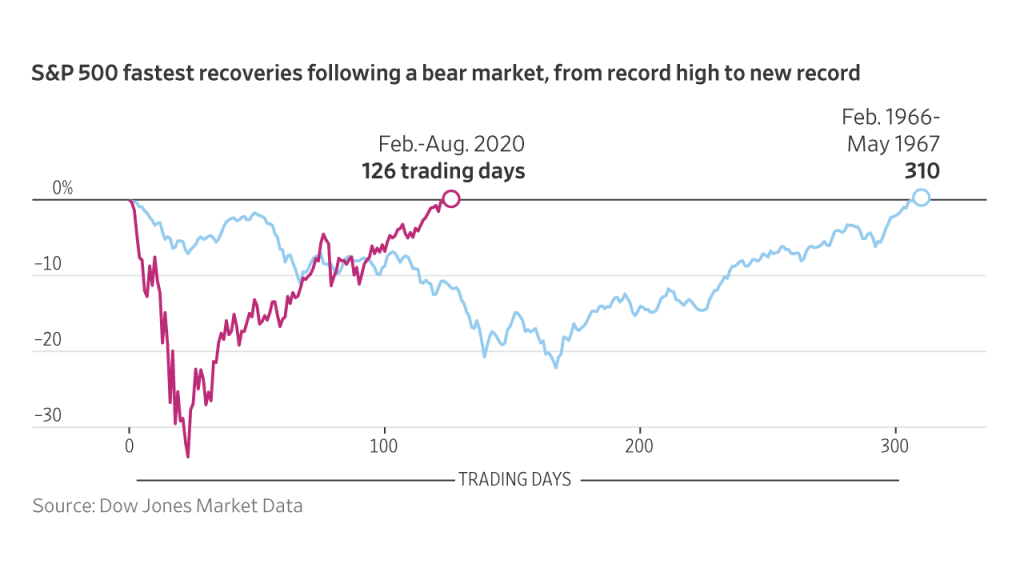
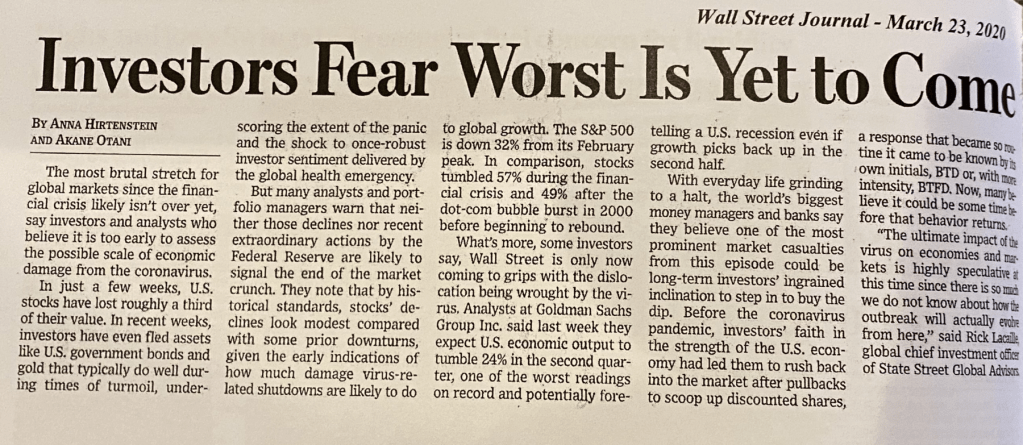
Here is a sample of some headline from March 20 and then the later part of 2020 and now.

These headlines incite “epinephrine” and “dopamine” to play havoc on your system.

Having said that, this is my observation of what goes on:

  • Investors invest on advice and not understanding.
  • They trust the advisor and often ignore the role of due diligence.
  • They don’t have the competence (which is fair, not everyone will have competence), however often they don’t even make the effort to be able to ask the right questions.
  • “Fear/Greed” makes them “fit” news into their pre-conceived “narrative” fueling “bad decisions” that cause regret
  • In “good times” and in “bad”, ability to stick to your investing discipline and asset allocation is tested and it becomes challenging for investors to do so successfully.

So, what do you do, how do you make the “Twain” meet?

Well, read the above para again and the last point a couple of times.

  • Develop an approach.
  • Stick to it with discipline
  • Develop a playbook of questions that you will ask for every investment decision
  • Have a thesis for every decision
  • Take pre-conceived notions out of the equation

The point is “fear” and “greed” come largely due to lack of understanding of where the decisions are coming from.

As long as you try to bridge this gap-you might succeed in making the twains meet.

Finally practice what John McEnroe (the legendary tennis player) said-

“I neither get so happy about my wins nor too sad about my defeats”.

If you stick to your discipline and are a “long-term investor” results will come if you can stick to your process.

Finally, as always “Stay the course”

The 100 Meter Marathon

Eliud Kipchoge is the current world record holder of the marathon world record.

He recorded a time of 2 hours 1 minute and 39 seconds at the Berlin Marathon in Sept-2018.

If he had to run a 100-meter dash at this speed it would take him 17.34 seconds.

The current world record for the 100-meter dash is 9.58 seconds.

Almost like half of the time at which Kipchoge will finish it as the speed at which he ran the full marathon.

Why am I sharing all this?

How does it make any sense at all?

Sublinear Models

According to the Kleiber law, any animal with a body mass of 150 g will have a basic metabolic rate that is approximately 7.6 times greater than that of an animal with a body mass of 10 g, i.e., metabolic activity of a small organism is, relative to its body size, much higher

If you look at it from standpoint of the concept of sublinear scaling in physics, ultimately things, companies, animal sizes stop growing and start dying.

Scaling is a deceptively simple way to think about cities and urban growth. Developed by Geoffrey WestDenise PumainLuis Bettencourt and others, the idea is that the kind of universal scaling laws that are observed in the natural world also apply to cities.

Biological scaling laws are common — larger creatures live longer, consume more energy and so on — but these links get weaker as organisms get bigger. 

So, it is easier to run very fast in a 100-meter dash than it is in a marathon.

The perfect analogy is how teams are now making scores of over 250 in a 20 over cricket match.

Well, it is easier to play and score at a rapid rate for a shorter period than it is for a longer period of time.

Longer the Game-Different the skills

Investing is a longer game.

You can’t keep hitting sixes every other ball when you have to do it over a 50 over game.

You are bound to make a mistake.

Why is “Rick Guerin” not as famous as Warren Buffet.

Of-course, you are now wondering-who is Rick Guerin.

He is the 3rd partner of Warren Buffett and Charlie Munger who decided to leave the partnership.

When asked about him, Warren Buffett’s response is- Rick was just as smart as us, but he was in a hurry. And so actually what happened — some of this is public — was that in the ’73, ’74 downturn, Rick was levered with margin loans. And the stock market went down almost 70% in those two years, and so he got margin calls out the yin-yang, and he sold his Berkshire stock to Warren. Warren actually said, I bought Rick’s Berkshire stock at under $40 a piece, and so Rick was forced to sell shares at … $40 apiece because he was levered. And then Warren went a step further. He said that if you’re even a slightly above-average investor who spends less than they earn, over a lifetime, you cannot help but get rich if you are patient. ”

Know the Game that you are Playing

If you are trying to run a 100-meter dash when you are participating in a marathon, the outcome wouldn’t be pretty and once you have grasped this, everything else will fall in place eventually.

Investing is a marathon, prepare your body (mind, in this case) to run the 2 hour plus that you will need to get to the finish line.

If 100-meter dash is what attracts you, this is not the game for you.

Happy Investing-Stay the Course

Why Even the Smartest need this Strategy?

Joel Greenblatt, the American Hedge Fund Manager and investor wrote “The Little Book that Beats the Market” in 2005 describing a 2-factor investing strategy.

The strategy was based on “Earnings Yield” and “Return on Invested Capital”.

The strategy was based on selecting the Top 30 stocks by ranking on these 2 criteria.

Investors who use the strategy sell the losing stocks before they have held them for one year to take advantage of the income tax provision that allows investors to use losses to offset their gains. They sell the winning stocks after the one-year mark, in order to take advantage of reduced income tax rates on long-term capital gains. Then they start the process all over again.

Greenblatt claimed a 30% outperformance through this strategy in his book.

Execution

The strategy looked great academically, however executing the strategy year-on year basis provided difficult when Greenblatt tried executing it.

Greenblatt’s book became a best seller; however, a lot of readers wrote back to him for help executing the strategy.

Subsequently in 2009, Greenblatt launched “Formula Investing” to help investors execute the strategy.

Investors had 2 options-DIY or ask the firm to execute.

How Did it Fare?

Formula Investing allowed money to be managed in a disciplined manner that removes factors, like excess emotion and future projections, that often lead to bad investment results. 

Over the next couple of years, Greenblatt realized, how the DIY investors did badly compared to those being helped by the firm.

The reason was simple, the DIY investor applied their instincts to using the strategy which meant piling on the strategy when strategy was doing well and exiting when markets were falling.

These were exactly the traps that the strategy was seeking to avoid.

Lessons Learned

There are no “rights” or “wrongs” in investing like a lot of other aspects in Life.

You do what is right for you and you don’t do what you feel is not “right”.

The key is can you follow this approach consistently and with discipline without mixing emotions and judgement calls.

There is always something to be worried about in the markets.

Can the “noise” be filtered to stick to your “discipline”.

If the answer is yes, you will realize that you do not need any “magic formula”.

You will get the outcome that your risk-profile determines without falling prey to day-to-day worries of the world.

Difficult, not “Impossible”

As we have realized, however, this is the most difficult part of investing.

It is not about right stock, right time, right platform.

It is about “Discipline”.

That’s what “Even the SMARTEST” need as a strategy.

Happy Investing and “Stay the Course”

Of Creepy, Crawley Change

Pace of change is often discussed at length and so many people would want it to happen even faster that how fast things are already moving.

However the “real change” can often go undetected as it is so much under the surface.

Surface of the earth is broken into 7 large and several small moving plates.

Each plate being 50 miles thick and moving anywhere between ½ inch to several inches per year.

Now think about it, if a plate moves only ½ inch per year, that means it moves:

5” in 10 years

50” inches in 100 years,

500” in 1000 years.

It will take 100 Million years to move 800 miles

That’s how the current structure of the earth was shaped.

The Cretaceous period began 145.0 million years ago and ended 66 million years ago.

Beginning of the cretaceous period, earth was divided into 2 supercontinents-

  • Gondwana in the south with South America, Africa, Arabian Peninsula, Middle East, India, Australia, Antarctica and several other smaller masses part of it and
  • Laurasia in the North with North America, Eurasia and Greenland part of it.

Africa had split from South America, the last land connection being between Brazil and Nigeria.

In Indian Ocean, Africa and Madagascar separated from India, Australia and Antarctica in late Jurassic to cretaceous period.

India began its journey northward, which culminated in a later collision with Asia during the Cenozoic era.

Most of western Europe, Eastern Australia, parts of Africa, South America, India, Madagascar, Borneo, and other areas that are now land were entirely covered with water.

All these changes in the way the earth is structured right now happened over millions of years.

Generations of living beings from the era might not even have felt the changes that was the pace of change.

Even while being aware of the fact, we can’t feel or relate to the fact that the earth’s tectonic plates are moving continuously even though at a very slow pace.

Change keeps moving your way

Change is happening all-round but a lot of times very difficult to detect.

CRISPR system first discovered in early 2010’s got its place in the sun during the covid pandemic leading to the mRNA vaccine.

It was there, tech was available but it took years to finally put it to application.

That doesn’t mean nothing was happening around it, only thing it tells you that steps that lead to meaning for larger populace can go undetected or recognized for a long time.

Investing is Hard

One of the factors that makes investing so hard is “What’s obvious” is usually priced in very quickly.

It’s the slow moving change and inability to recognize and persist with it as it happens that can not only test your patience but frustrate you at times when you are proven wrong.

The entire paradigm of investing changed over the last 20 years as company valuations shifted from tangibles (plant, machinery, buildings) to intangibles (human capital, Innovation, tech, R&D).

Apply some short-cuts?

Everyone who is a serious investor knows that there are no short-cuts.

So What’s the long-cut: frankly it’s tough for those whose day job is not investing.

But still there are a few things that you can do:

  • Read-not about investing but about trends; read medicine journals; chemical discoveries; new usage;

Remember– It was the Scientists working for Danisco, a dairy food production company, were looking for a way to protect their yogurt bacteria, Streptococcus thermophiles, from virus attacks. Danisco’s scientists confirmed that the CRISPR system was involved in anti-virus defence of the yogurt bacteria. But how it worked was not learned until a few years later.

  • Be Inquisitive-As you look at your favourite brands; think about what’s new happening in those sectors and how it’s get adapted and maybe there is a new investing idea lurking there
  • As you look for Managers, look for ones who are not just benchmark huggers but the ones who are recognizing trends early; Align with them closely;
  • Ask you advisors and managers not about investing but what is it that they do with their team, what do they read and what are their objectives

Sounds tough-yes, cause it is.

The idea is not to get demotivated but become conscious and that might help you make better decision.

Happy Investing-Stay the Course.

Of Black Swans and Grey Rhinos

Aesop’s fables that came to us via the oral rather than the written route was about allegories and humor with a moral lesson.

Take for example the story of the Eagle and the fox who made a pact to live in peace.

The eagle had a nest on a tree, and the fox made its home in the bushes near the tree. The fox had baby foxes and then went hunting. The eagle came and took the baby foxes and gave them to his children.

The fox was sad about it but did not know how to get her revenge. Afterward, the eagle stole a piece of meat from the shepherds while they were cooking it. Eagle wasn’t careful enough, and he brought some ember with the meat. The nest caught fire, and the little eagles fell out of it.

The fox came and ate them all. She got her revenge by accident.

The first part of the fable is the storytelling part and the second one carries the moral of the story. The lesson is that everyone who lets down a friend will pay for it.

It’s not a Black Swan, it’s a Grey Rhino

Fox believed that she and the eagle could be friends. He let her down which was expected. She was sad when he ate the little foxes but mostly, she was sad because she couldn’t get her revenge. At the end, we see that she is revengeful because she couldn’t wait to pay the eagle back for what he has done.

“He let her down which was expected”.

That’s the key, risk was there.

Trust replaced the risk and lulled the fox into false sense of safety, and it didn’t play out.

Black Swan is usually an event with low probability of happening and hence takes you by surprise.

On the other hand, Grey Rhino is an expected risk and that’s why gets discounted, and people don’t plan for it.

Grey Rhinos can become black Swans

Behind every supposed black swan is a “crash” of grey rhinos (“crash” is the zoologically correct term for more than one rhino). You had several potential dangers in 2007 and 2008, and many people sounded the alarm. The black swan emerged when all these obvious dangers interacted, creating a problem much bigger than any one of them. That’s very hard to predict. It’s very hard to tell where it’s going to go — and how big it’s going to be. With grey rhinos, it’s generally a case not of if but when. If they all blow up at the same time, that is your black swan.

You’ve a choice to do something about it or not. It’s a metaphor for the fact that so many of the things that go wrong in business, in policy, and in our personal lives are actually avoidable.

We don’t pay enough attention to the big obvious problems that are in front of us. By regularly doing a grey rhino reality check, you can be way ahead of your competitors and your peers.

What Should you Do?

Ask yourself some simple questions:

  • What is my grey rhino?
  • What’s the big thing in front of me that’s going to trample me unless I do something?
  • How good a job am I doing in dealing with it?
  • Have I properly accounted for the cost of not dealing with it?
  • How much power do I have to change it?
  • If I have the power to do something, then what’s my goal?
  • Is it just getting out of the way?
  • Is it to turn the challenge into an opportunity?
  • If I don’t have the power to do something, then who does have the power? What can I do to get them to change the situation?

Investor’s Dilemma?

The 1st instinct of every investor is of-course fear.

And there is always something to fear.

The question is not just about the fear but what’s your strategy to face it?

Markets on an average correct 15-16% every year and that’s feature not a bug in investing.

If you can’t take that risk, you shouldn’t be in the market

Peter Lynch (legendary Fidelity Manager) in his book-A walk down wall street taught us how to identify a good business and then wait for market imperfections to buy them at the fair price.

These annual corrections that might/might not happen for a reason are your opportunities to create value for your portfolio.

Embrace them instead of fearing them

In-fact by identifying “grey rhinos” that can have an impact on the market, you can have your dry powder ready to take advantage of them.

End of the day, equity investing is about “risk-profile”.

Take as much risk as your risk-profile dictates so you can sleep well at night and then long-term compounding do its magic.

This is not a short-term game and “grey rhinos” help you increase your ability to take advantage of the short-term anomalies.

Happy investing

Follow my twitter handle @manver1974 for more such shares

Ghosts of Memories Past

“Below the smooth surface of official accounts of history, lie those stories that have been silenced and erased, leaving only their ghostly traces, and therefore bound to return and haunt the present.”

~ José Colmeiro, A Nation of Ghosts

An experience, any experience with painful memories shapes reactions and action for a long time.

An accident, a violent crime, even sudden death of a near one makes humans wary of action that could lead to a similar outcome.

The event and its after-effects might fade into past, and normal life might begin its “treadmill existence”, however some-where at the back of your mind, the facts, perceptions, and memories refuse to go away.

Patricia Hampl puts it in her book I Could Tell You Stories: Sojourns in the Land of Memory:

 “Memory,” she says, “is not a warehouse of finished stories, not a gallery of framed pictures.”

Basically, memories are like reading a book.

Each time you re-visit, new facets come-up that you had not realized earlier.

A new way of looking at memories become evident and that can change how you narrate the memories over time.

The “Lehman” Moment

Every-time since 2008, a financial institution or related party gets into trouble, the “Ghost of Lehman” is resurrected.

Lehman was the poster boy of 2008 Great Financial Crisis.

Charles Prince famously said about Citigroup’s continued commitment to leveraged buy-out deals, despite fears of reduced liquidity because of the occurring sub-prime meltdown: “As long as the music is playing, you’ve got to get up and dance.”

Everyone was dancing and no one seemed worried.

Every large balance sheet had leveraged products that had been collateralised several times over and ultimately most boards realised that no-one knew how much shit they were carrying.

The lucky once sold early (read JP Morgan), others got bailed out (Citi, AIG Bank of America, or acquired (Merrill Lynch).

Lehman was left to hang dry.

Is that What’s Happening to Evergrande?

Chinese govt. has been changing its policy on unbridled, unquestioned growth.

China’s new principle of “homes are for living in, not for speculation” and ensuring that risk is contained pro-actively is playing out here.

Evergrande is that poster boy for that lesson to other developers.

“Fear of Death” not Actual “Death”

Sigmund Freud said “Goal of every life is death”.

Its inevitable, however humans still fear death.

But if someone actually dies, there is no fear.

China is perhaps invoking that Fear to make people fall in line and promote its “Common Prosperity theme”.

Or maybe not

But one thing seems clear that this is a self-induced situation and hopefully China is in control.

Risk

Anytime you can anticipate, visualise or see a risk-it stops being one.

The reason being that then you can plan for it.

What your plan will be a factor of your “risk-profile”.

Risk-Profile

Risk-profile is a personal issue that makes sense to one individual but might not make sense to another as they might have a different risk-profile.

The idea is to stick to it rather than fight it, because that is what will give your peaceful sleep at night.

So if a 20% crash which is “par for the course” for stock markets is not for you, you should not be participating in the markets.

On average a 16% crash has happened in stock markets every year and it is definitely not everyone’s cup of tea, which is a very fair way to look at the markets.

What should you do?

  • Measure your risk-profile;
  • Attune your mental approach to “how much loss can you take”
  • Markets can surprise you in the opposite direction for a long time, so be prepared for regret of losing out on “what happened” vs. “What you thought would happen”
    Decide clearly whether you are in the camp that takes advantage of a crash or sitting it out.

It’s important for investors to write down their strategy and re-visit it.

Avoid regret at any cost.

And finally as always “Stay the course”

Use the Dip

The perpetual battle between optimism and skepticism, fear and hope drives investor behavior to sit on cash and wait for the dip.

Different people have different take on it.

However universally financial advisors and experts seem to agree that for average retail investor it is better to invest using methods like Dollar cost averaging (popularly known as Systematic investment plan or SIP in India).

Buying the dip can produce positive results (especially in hindsight) if you are able to buy the dip.

However, in our actual experience most investors waiting for the dip become even more paranoid when the dip comes fail to act/react and end up missing it.

Nick Maggulli (Twitter avatar @dollars and data) had recently shown how investors will find it tough to execute “buy the dip”.

I believe while buying the dip might be difficult and dealing with the psychological impact of the dip and calmly executing the strategy might be even more straining on the investor.

However, is there an opportunity to “use the dip”.

Since 1998 January, (I took this date as this is pre-dot com bubble when markets were still on an upswing), there have been 57 instances of markets falling by 5% of more during a week.

We are talking about 1235 weeks here.

An investor using weekly SIP (Dollar cost averaging) of INR 100 would have saved INR 123500 over this period.

However, if the same investor would have set-up a rule to use every 5% dip to increase the weekly contribution by 4X, thereby saving INR 140,500, the result would have been dramatically different.

In-fact high time Mutual Funds provide this option to investors to automate the process and help an investor not only save but even invest more.

While this is highly intuitive, lot of investors keep focus on trading, the new investments ideas and waiting for the dip, that they are not able to focus on something which is simple and intuitive to execute.

Happy investing and “stay the course”

The Music is On

In early summer 327 Alexander left Bactria with a reinforced army of 120,000 towards India.

Recrossing the Hindu-Kush, Alexander divided his forced into 2-hald going towards Khyber Pass while the rest being led by himself towards the hills in north.

In 326 BC he entered Taxila whose king supported him against his rival Porus.

The battle with Porus was his last great battler post which Porus also became his ally.

He was anxious to press on farther, and he had advanced to the Beas river when his army mutinied, refusing to go farther in the tropical rain; they were weary in body and spirit, and Coenus, one of Alexander’s four chief marshals, acted as their spokesman. On finding the army adamant, Alexander agreed to turn back.

Courage and aspiration were his poison.

His success and the meek surrender by his enemies made him arrogant leading him to believe that he was akin to God.

He was on a song and wanted to keep “dancing”

Courage and Arrogance are not a Plan

However as we have discovered in our lives courage and arrogance might help in creating self-belief, success depends upon several factors beyond personality characteristics.

Alexander’s arrogance was largely responsible for his own premature death; and he was personally culpable for the failure of his imperial enterprise. For Alexander was king of a society where the ruler was absolutely central to the well-being of society as a whole. When the king failed, the Macedonian kingdom imploded, something which had happened every generation for two centuries before him and happened again when he died. For the good of his people, Alexander needed an adult successor, but he refused to provide one while also killing any man who could be seen as one. The consequence was fifty years of warfare after his death and the destruction of his empire.

His confidence in himself and disdain for planning for the future destroyed a “Great Empire”.

What’s the Plan?

In Bull riding the rider gets on a large bull and attempts to stay mounted as the bull attempts to buck off the rider.

In the American tradition the rider must stay atop the bucking bull for eight seconds. Strapping yourself to 2000 pounds of ferocious, muscle throbbing, red-eyed bull takes guts. It wants nothing more than to buck you off and then stomp you into the ground. You have to balance your body with nothing more than one hand holding onto a bull rope wrapped around a heaving animal that’s out to get you. You have to be able to visualize the ride, the twists and turns. The mental ability is just as important as the physical ability when it comes to bull riding.

In addition, you have to know the proper technique for preparing yourself in the chute. You have to get on the bull, maintain balance, and be ready to anticipate that first move by the bull as it explodes from the gate. What’s more important, you need to know how to get off. The last thing a rider wants to do is get hung up and not be able to free their hand from the bull rope. When this happens the results can be disastrous.

So you see riding a bull might last only 8 seconds, the preparation can take a life time.

Nifty at “Record highs”

Every day news channels and papers shout their lungs out as Nifty touches record highs.

Investors indeed are riding the bull.

However are you prepared for the fall?

Ask yourself these questions:

  1. Do I know what I am doing?
  2. Why and what am I investing for?
  3. How much do I understand about what I am investing in?
  4. What are the risks associated with a particular investment?
  5. How much loss can I take?
  6. How would I feel if market drops 20-30% in a matter of days?

Prepare for the Journey

All long run charts of stock markets look similar-one way up.

However there are troughs and the investor needs to ride them to.

It is important to prepare yourself for the Journey.

Either develop an understanding or have an advisor/coach who can be your sounding board.

The cost associated with spending your own time or purchasing someone’s else time will be more than worth it if it helps you ride the bull

Do follow my twitter handle @manver1974 for more such shares

Marketing

Emotions affect decision making more than anything else.

Jealousy, hope, desire, fear have been used by marketers to make people buy things they might/might-not need.

Fear is “an unpleasant emotional state characterized by

anticipation of pain or great distress and accompanied by heightened autonomic activity

especially involving the nervous system

Fear is “an unpleasant emotional state characterized by

anticipation of pain or great distress and accompanied by heightened autonomic activity

especially involving the nervous system

As defined by Merriam-webster “Fear is an unpleasant emotional state characterised by anticipation of pain or greater distress”.

Fear is easier to evoke as societal, environmental, and even evolutionary reasons create insecurities in human beings which can create platform for fear.

For example, reacting to a nonexistent threat like a snake which is a stick happens because the brain is wired to flinch first and ask questions later.

Tail Risks-The Unknown

Think about it more people have died of car accidents in India than terrorist attacks.

In 2019 alone 151000 people lost their lives to road accidents compared to around 7500 lives lost to terrorist attacks since 2001.

However, no politician ever raises the bogey of road-safety to win elections but each politician worth its salt will raise the bogey of terrorism to rally the populations.

It’s the “tail risk” associated with the terrorism, the unknown, the sudden which creates the fear factor.

Road accidents happens so often that somehow, they have become normalized and do not evoke fear.

The FEAR Appeal

A fear appeal has 3 main components-fear, threat, and perceived efficacy.

Fear creates psychological arousal;

Threat creates external stimuli to act and

Perceived efficacy provides the messaging that somehow the solution suggested can be implemented to take care of the fear.

A fear marketing campaign needs a credible threat or important problem and specific direction on reaching the solutions.

Look at this as an example:

This is FOMO marketing at its best, gives you an important problem and provides a link to reach out to the solution and gets you where you want your audience.

There is a fear, threat of missing out something important and solution to keep yourself updated.

In financial marketing, often the audience thinks that fear marketing is only about negatives.

As with all marketing techniques, this has its own advantages, and the real challenge is in appreciating that fear marketing can even induce positive behaviors.

And as with every technique, there will be misuse.

Investing

In investing, the most common technique (sometimes even without invocation) is “FOMO”.

  • Invest now
  • Next best business to own
  • If you don’t own this
  • This time it is different, go all in

It is easy to make investors believe that markets will always go up and make them take irrational decisions.

As an investor, the way to think about “fear marketing” is to keep a few things in mind:

  • Stepping back; Remember there is never any hurry to take a decision unless you have understood the decision and implications in full.
  • You don’t have to react which doesn’t mean you don’t have to act
  • Asking the messenger to describe the situation, problem case with clarity
  • Ask “why” X solution is better than Y.
  • More descriptive you ask the salesman/marketer to be, better will be the quality of solutions
  • Invert the problem

Your “PLAN” is your “PATH”.

Staying on it requires discipline and rigour and not reaction.

“FEAR MARKETING” invokes “REACTION” but you don’t have to give reaction.

Its controllable and like everything will require practice and ability to ask the right questions.

Follow my twitter handle @manver1974 for more such shares